For my money the conversations between Richard Rohlin and Jonathan Pageau on YouTube discussing "universal history" are perhaps THE most fascinating content on all of the internet.
Pageau is an Eastern Orthodox (former Baptist/Evangelical) artist and popular YouTuber. Rohlin is a former Baptist minister (I'm sensing a pattern here) who is now (if I'm not mistaken) a deacon in the Orthodox church.
Here is Rohlin (without Jonathan) discussing Tolkien's "Legendarium." This video - like all of the Universal History series - is WELL worth your time.
I'm not a regular Tucker watcher by any means, but I was intrigued by the title of this one when I saw it on YouTube. I've become more and more an advocate for keeping physical books, because more and more unseen web-editors are able to "tweak" the information we have access to online - or just remove it. Many of us have seen "Wikipedia wars" as articles are edited and re-edited by contributors with opposite interpretations of a given event. Of course, we all remember the confusion, contradictory messages, and moves toward censorship in 2020. Many of us were left wondering, "Which voices can I even trust?"
I've been wondering for a while if physical reference books like dictionaries and even physical encyclopedias are going to suddenly become more appreciated, and perhaps even make a little comeback in terms of sales.
So I was curious about what Tucker would say in this clip. His comment about "only work with things you can smell - pets, people, physical books" in an increasingly digitized world reminds me a bit of Gandalf the Wizard's quip: "When in doubt, always follow your nose."
If nothing else, this line of reasoning gives us a justification for the purchase of yet another book.
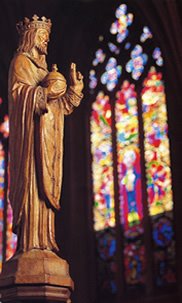
I spent years as a child attending mass at my Roman Catholic School. Each week we entered a church, fragrant with with candles and hints of incense. Before us were statues of Jesus, Mary, and Joseph, and a statue of Christ crucified, as well as a priest wearing colorful robes. Surrounding us were dazzling stained glass windows depicting numerous Biblical stories and saints and Christian symbols, much of which I did not understand...but it clearly meant something.
Later in my youth I joined a fervently evangelical Baptist Church. Many evangelical churches - especially those with roots in the Puritan and Anabaptist traditions - have mostly eschewed iconography and art...though it does have a way of sneaking in from time to time anyway.
Indeed, when the church I attended remodeled its sanctuary (about the time I moved away for college), I was pleased to see that they replaced their opaque purple windows with far more colorful and attractive stained glass windows, each with identical images of the Cross.
These two churches point toward the different approaches Christians have taken to sacred art. Some Christians (those in the Puritan traditions) have looked with suspicion on all sacred art as potential idols that break the Second Commandment, which says: "You shall not make for yourself a carved image [or 'idol']...you shall not bow down to them..." (Exodus 20:4-5).
Other Christians have pointed out that later in the Book of Exodus itself God instructs his people to build a beautiful tabernacle of Gold and fine cloth and carpentry in which to worship Him, complete with images of plants and angels and golden statues of angels as well. These Christians (including Catholics, Eastern Orthodox, Anglicans, Lutherans, Methodists, and others) have to varying degrees embraced sacred art as an important reminder of the creativity and beauty of God.
I too have come to believe that works of artistic Beauty actually have profound theological significance. You may note that this is a theme running through my recent posts since the Notre Dame fire.
Not only do I believe works of Beauty have profound theological significance, but also that they will be an important pointer to the reality of God for some who may not be swayed by Reason or logical arguments for God's existence.
I've heard that Dostoyevsky, a Christian author who wrote the profound and theologically significant novel Brothers Karamazov (among others), once said "Beauty will save the world." I think there is truth in that.
In the beginning, the Bible tells us, God created the Heavens and the earth and all that is in them. "And God saw everything that he had made, and behold, it was very good" (Genesis 1:31). The word for "good" in the Greek version of the Old Testament that was used by many of the early Churches is 'kalos' which means "good, excellent, and beautiful."
But no one who has ever gazed upon the stars, or stood on the rim of a great canyon, or watched the setting sun needs a Greek or Hebrew word study to tell them that God's creation is beautiful and that He is a wondrous creator. And note: Man was formed in God's image, which accounts for our tendency to create beautiful things as well. J.R.R. Tolkien, a devout Christian whose magnificent work The Lord of the Rings contains a great many Christian themes, quite consciously saw his work in creating a fictional world as a reflection, however small and imperfect, of the world-creating work of the Living God whose image Tolkien was created to bear.
We have a good and beautiful God who creates a good and beautiful world (though it later became distorted by sin), and he populated it with people created to bear his own image who are themselves blessed with great creativity and love to make wondrous art to the glory of God. This is why Christians across the ages have written amazing works of literature, composed lovely music, crafted intricate statues and gorgeous stained-glass windows, painted icons, built inspiring sanctuaries and cathedrals.
Even among Churches of the more Puritan traditions you will almost invariably find quite handsome pulpits and very nice leather-bound Bibles with gold-gilt page edges, and will hear lovely hymns being sung, which are all types of sacred art. We humans cannot get away from this because we are embodied creatures who are creative by nature.
Fr. Patrick Smith, an Anglican priest who was a mentor to me in college (in explaining why his own Episcopal Church put such emphasis on beauty and artistic excellence, and was willing to commit resources to them) pointed out that God certainly does not disapprove of the material world or physical beauty - in fact he created it; and in the Incarnation of Jesus Christ he brought the very Life of God into the world of material stuff, transforming it forever.
This is the theological basis for embracing sacred art.
But such an embrace of beauty also strengthens the mission of the Church as well, which brings me back to the quote from Dostoyevsky: 'Beauty will save the world.'
There are many compelling logical arguments to believe in God. Yet Beauty has a persuasive power that transcends logic and reason; Beauty has the power to resonate with us on a very deep level; beauty stirs our longing for Him who is the fount of all the beautiful things, the source of all songs and wonder. We glory in all this beautiful sacred art not simply for its own sake, but also because it serves as a pointer to Him whose life is forever a Dance of supremely Beautiful, Sacred, and Divine Love.
It is into that Triune Dance that we are called by the same Christ who is also the true Way for us to get there.
I had an experience a few years ago that powerfully brought this all together for me (again). I went with a group from the church I was pastoring to Saint Joseph's Abbey in Covington, Louisiana for a quiet retreat. Our group was invited by the monks to join with them in chanting the Psalms at their prayer offices sprinkled throughout the day.
On our last night of the retreat, a storm rolled in after we had attended Vespers (Evening Prayer) and eaten dinner. At first there was no rain, only a howling wind, and distant flashes of lightening and sounds of rumbling thunder. I decided to walk to the glorious Abbey Church rather early before Compline (Late-Night Prayer), in order to beat the rain. I found the church very dark - lit by a single candle in the sanctuary - with flashes outside occasionally lighting up the whole place. When the rain started it came down hard and loud. I sat down to pray and, after a few minutes in the quiet, turned on my MP3 player, and this is what I heard (close your eyes and imagine you are sitting in the vast, dark Abbey, with the storm raging outside):
Actually, the exact recording I heard was this one (which is even better, but has an annoying commercial before it).
I tell you, this experience was like another conversion. In that moment I felt that even had I been a militant atheist I would have been converted to faith in Christ by the sheer transcendent beauty of the experience.
Indeed the words of the repeating chorus are the traditional Ave Maria ("Hail Mary") - half of which is taken from Luke chapter 1. The other words of the more plain-chant sounding verses are also taken from the Birth narratives of Christ (such as Luke 1:38 and John 1:14). The song tells of the embodiment of the Good and Beautiful Creator God in the flesh, through the Virgin Mary, taking up residence in this material world. The song was not only about the incarnation of God in Christ in the world, but the beauty of the song, and of the Abbey where I sat, were indeed embodied, that is incarnate, witnesses to this same spiritual reality. It is hard to fully put into words how Beauty and Truth came rushing together upon my soul in those moments of meditating upon the beauty of the Incarnation of Jesus.
By comparison, the worldviews of atheism and secularism and the kind of "generic popular culture" that secularism produces is utterly incapable of producing anything like this kind of sublime experience of deep soul-stirring beauty. They can entertain, but they cannot inspire anyone with a genuine experience of transcendence; indeed, for these worldviews, there is no actual transcendent Reality beyond our own feelings. For this reason, they simply haven't the spiritual depth and mystical freight that is necessary to drive men to erect cathedrals or to inspire the writing of Mendelssohn's "Lift Thine Eyes," or to sustain our Civilization into the future.
The fact that such timeless works of art exist at all, points us to the truth that there is indeed a Transcendent reality - a Divine Logos - And that Word, that Logos, says the Christian faith, was became flesh, and dwelt among us, and his name is Jesus.
So let the people of Jesus - in word, deed, character, and work - be people of creative and life-giving beauty.
I've made something of a commitment to myself to spend more time focused on fewer hobbies and activities, which is one reason I have not been blogging so much in recent months, and that blog posts are not as long as they often were in years past (this blog is actually approaching it's 10th Anniversary!!).
Though not writing as much on this forum, I still want this to be a place where serious ideas are shared. Since I still read a good many (perhaps too many) online articles - from news and political analysis to theology and philosophy - I have decided to start a doing "Round-up" posts with links and brief summaries of the most interesting or significant articles I've read in recent days. I've done this before, but now it will be a regular feature of this blog (or such is the plan).
So, here is today's Round-up of Recommended Reading:
1) Young adults and Church:
There has been much wringing of hands over the much-discussed decline of Christian faith among young people (or at least, the decline in the number who identify with traditional denominational labels when surveyed by pollsters - God only knows about faith). Should we become more liberal on sexual morals since that is in fact where many younger people are on those issues? Or should we become more conservative since it is in fact the more conservative congregations and denominations that are actually reaching and keeping younger people for Christ? Along side this debate we've also seen on-going debates about whether churches should adopt more liturgical or more contemporary/rock-music type worship services in order to keep younger folks in church.
Yet, according to the Huffington Post, research has revealed many of these debates might largely be "adventures in missing the point." The single strongest indicator of whether younger people will become and remain committed Christians is whether their parents take the Christian faith seriously and promote faith in Christ at home. Check out the article HERE.
So as a pastor may I ask: is it time for your family to establish a home altar or a family prayer time? Do you ever discuss the significance of the Bible around the dinner table with your children?
2) When support for Gay 'Marriage' turns ugly (and irrational):
After the somewhat hysterical, but not always well-informed (but nevertheless politically successful) reaction to the religious freedom law in Indiana and other states, we've (thankfully) seen a bit more discussion in public forums about freedom of speech and freedom of conscience for religious and social conservatives, who are now a new minority in this country.
One such article was THIS ONE at The Week. Ryan Anderson, a prominent, young, and articulate marriage traditionalist has been "shunned" by his Alma Mater because a vocal group of marriage liberals insisted on it. The author of this piece is himself liberal on the marriage question, but wonders if we are seeing a movement in the direction of suppression of free and open debate of freely-expressed ideas. He also wonders whether the ability of future generations to debate ideas reasonably will erode and indeed whether we will in fact raise up a generation of "cry-babies" unprepared for the challenges of the real world should our great institutions always give way to those who shout most loudly and frequently how 'offended' they are about whatever it is they happen to disagree with or dislike.
3) David Brooks' new book on Virtue and Character:
I must confess that I have always found David Brooks to be a refreshing voice in the contemporary media world. He is one of the very few calm, thoughtful, and articulate conservatives who regularly gets a hearing on NPR and PBS. I have also been intrigued for a while by the fact that Brooks is also Jewish, a child of Abraham. The Christianity Today editors also apparently like him, because they've featured his new book on character HERE.
4) The Lasting Influence of the Inklings:
Dad sent me THIS somewhat long but very engaging piece from The Chronicle of Higher Education celebrating the lasting influence of the Inklings of Oxford - a group of Christian authors including C.S. Lewis, J.R.R. Tolkien, Charles Williams, and Owen Barfield among others. Compared with their (at the time, more fashionable) secular counterparts in the literary world, the Inklings have had a greater influence on mainstream culture, and are coming to be more recognized in serious academic circles as well.
This weekend I watched, and thoroughly enjoyed, the new movie "Snow White and the Huntsman." One of the better fantasy films to come out in recent years, it was at times reminiscent of "The Chronicles of Narnia" films and the 80's fantasy classic "Excalibur," or even "The Princess Bride." This review does contain some vague spoilers.
Fantasy fans will not doubt like this film: If you enjoy watching a cavalry charge of knights in shinning armor, their colorful banners snapping in the wind; or a castle seige that hangs upon the heroism of some stout little dwarves; or sweeping vistas of a mystic land (filmed in the UK), or fantasy characters trying to fight off a surprise attack from a giant troll (with an interesting take on an old tale), then you will probably enjoy this movie. The "Mirror on the wall" scenes are pretty eerie but imaginative as well.
On a spiritual level, there were certainly some notable elements in this film: there were at least some suggestions that Snow White and her family are Christians such as the numerous bishops present for her father's wedding scene and Snow White herself whispering The Lord's Prayer before she escapes from prison. In fact, you might argue that the film at least implies that her "spirituality" is one reason for her purity and ability to overcome the evil queen. Plus there is a "power in the blood" theme running through the movie as well with Snow White as a Christ figure (she even dies and returns to life, though this in and of itself doesn't seem to accomplish too much).
The film also, much like Lewis's work, portrays and invites us to that almost inarticulate desire for the Presence of the Creator and for the New Creation he brings, in one scene in particular. Within the green "sanctuary forest" that has avoided the general decay of nature that is seen everywhere else in the realm, there is a notable stirring among the many animals as beams of light fall down on a place - a giant "tree of life," actually, where Snow White receives a blessing from one whom the dwarves quite excitedly refer to simply as "Him." With the forest was coming to life around them, one of the dwarves smiles and said, "Yes, it's Him!" I quite expected to see Aslan the Lion walk from behind a rock, but this good power (whatever he is) manifests Himself as a huge White Hart or Stag. The Hart later bursts into a swarm of white butterflies when this moment of almost palpable holiness and blessing is disturbed by the forces of evil.
There is plenty of material in this film to explore about the meaning of love or of beauty, and selfishness versus compassion. In fact Snow White's compassion and purity actually overcomes a monster and save the heros in one scene, when she looks deep into its eyes and some of her compassion "rubs off on it," so that it decides to back down from the fight. She has a contageous spirit of goodness about her in the film. Snow White even seems to feel genuine sorrow for her nemesis as well - I half expected her to offer words of forgiveness to the evil queen in the end. So this was certainly not the blustering rage of so many American "revenge flicks", where the only way to overcome monsters is to kill them, or the final moments of your nemesis' defeat are best spent saying things like "That's for my family!" (which Snow White indeed could have said), not shedding a tear of pity for your enemy. Christianity Today's review is here.
Like the fantasy classic Excalibur (based on the Arthurian legend), and Tolkien's Lord of the Rings, this film ties the prosperity of the realm - even nature itself within the realm - to the health, strength, and righteousness of the sovereign. It is one more pop-cultural expression of a collective yearning that, I believe, is ultimately for the healing Reign of Christ over all things. We somehow know in our bones that when the right king is in charge, things will be made right (and it is immediately evident that our democratically elected politicians do not fit the bill). Thus we are overjoyed to see Aragorn finally crowned at the conclusion of "The Return of the King," and so it is also with Snow White's coronation in this movie.
All-in-all, I do expect to watch this one again. It has some action, violence, scary images and some black magic that is gross (involving bloody animal insides and whatnot), so concerned parents should take seriously the PG-13 rating. The costumes, visuals, and music are all excellent.
The Saul Zaentz Company, which owns the rights to various "Hobbity" things, is suing a pub in England that has been called The Hobbit for 20 years. Stephen Fry, a star in the upcoming Hobbit movie, has spoken out (well, actually Tweeted) in defense of the Pub. The full story is here.
The Bilbo Baggins Pub (which may be even older) in Bossier City, Louisiana better watch out! Lawsuits sometimes seem designed to destroy everything fun in life. Remember when fast food places actually had playgrounds? Plus I've no doubt that Tolkien would appreciate a good pub.
Just in case any of you haven't seen this yet. Only one year to go. This is without a doubt the most anticipated film (for me personally) since the most recent Indiana Jones movie...which reminds me not to get my expectations TOO high. But the trailer is certainly wonderful!
The 'Eagle and Child' pub in Oxford (England) is the much celebrated meeting place of the 'Inklings,' the informal literary and philosophy discussion group that included such luminaries as C.S. Lewis, J.R.R. Tolkien, Charles Williams, Owen Barfield, and others. While the group did meet in a couple of other pubs around Oxford, the 'Eagle and Child' is most associated with the group.
(I took the picture on the right on a pilgrimage to sites in Oxford relating to C.S. Lewis, the Wesley brothers/early Methodism, and Archbishop Thomas Cranmer).
Half a world away in Baton Rouge, that great American college town, we find "Lunch with C.S. Lewis" drawing crowds of hungry Louisiana State University students at St. Alban's Chapel (a ministry I frequented in my own college days, and the chapel wherein my beautiful wife and I were wed). Check the article at The Living Church. The local paper's take is here.
Crowds gathering to discuss Lewis isn't all that surprising perhaps, given his popularity. But we also see that there is, at least for some people, a true hunger for Christian teaching that is a bit more intellectually rigorous than what most sermons and Bible studies offer, while remaining more theologically orthodox than some other academic theological resources.
How do you think our churches can do a better job of inviting people to think more deeply about the faith than they might otherwise do? I've noticed churches in several cities sponsoring "Theology on Tap" discussion groups (or even lectures) in local pubs - is anything like that happening in your area?
"Out of the darkness of my life, so much frustrated, I put before you the one great thing to love on earth: the Blessed Sacrament...There you will find romance, glory, honor, fidelity, and the true way of all your loves upon earth, and more than that: Death - by the divine paradox, that which ends life, and demands the surrender of all, and yet by the taste (or foretaste) of which alone can what you seek in your earthly relationships (love, faithfulness, joy) be maintained, or take on that complexion of reality, of eternal endurance, which every man's heart desires."
-J.R.R. Tolkien, letter to Michael Tolkien 6-8 March 1941; from Letters of JRR Tolkien (1981), p. 53-54
One of the wonderful websites that you will find linked on Gloria Deo's right-side bar is The Front Porch Republic. Like many of the sites I recommend, I don't check in on this one nearly often enough, but they often have fascinating articles and commentaries, generally encouraging the renewal of genuine community - and with it a more genuine politics in American life.
They have had articles celebrating the "new urbanism" that we see in many American cities - including my own city, Lafayette - in which new developments (or renewed downtown areas) include homes, grocers, coffee shops, all close together to promote walking (instead of driving) and more interaction with one's immediate neighbors. I think this is a very important and positive move towards helping isolated Americans find a more real community.
I see two other potential trends that I also believe are very healthy. Last year Americans moved less. They stayed more. It is difficult for an individual or a family to become rooted in any community if their job frequently causes them to move to a new place. There were less movies primarily because of the poor economy, and as commerce picks up again (assuming it does) then presumably so will mobility. But hopefully the experience of staying longer in one place will convince more people of its value. Hopefully as technologies are better utilized by companies, the physical location of any given employee will become more flexible, allowing people to stay longer in a community they connect with.
The other trend I see (even in my own family, but also in television ads) is that more people are attempting to grow more of their own food - even if it is only a couple of vegetables in a flower-bed garden. There is a growing desire not to have over-processed and artificial food for health reasons, but also for reasons of environmental protection (why burn fossil fuels bringing me a tomato from California when I can grow my own) and social justice (why buy food produced by pseudo-slave labor in the Far East when I can grow my own).
There is, I believe, another positive reason to support this last trend: renewed connection to the land. For most of human history, our ancestors have felt a deep connection to the land that sustained them. This shaped they way they thought of their world, even the nature of language itself. For most of us that connection has been obliterated by a reliance on the artificial. Reforging that connection will, I believe, have many great benefits - even on a spiritual level for Westerners.
I got to thinking about all this recently thanks to this cool quote from J.R.R. Tolkien:
"[Family life must have been different] in the days when a family had fed on the produce of the same few miles of country for six generations, and that perhaps was why they saw nymphs in the fountains and dryads in the wood - they were not mistaken for there was in a sense real (not metaphorical) connections between them and the countryside. What had been earth and air and later corn, and later still bread, really was in them. We of course who live on a standardized international diet...are artificial beings and have no connection (save in sentiment) with any place on earth. We are synthetic men, uprooted. The strength of the hills is not ours."
- J.R.R. Tolkien, from an unpublished letter to Arthur Greeves, June 22, 1930.
The 'strength of the hills' may not be ours again for sometime, but the strength of the soil pot or the back-yard garden is a nice place to start.