I believe in bishops. I've had both really good and really bad experiences of Episcopal oversight, but experience is not what drives my belief system: the Bible interpreted through the historic church is. That is why I believe in bishops.
I know that this is an active topic of discussion among Methodists - and the Global Methodist Church in particular will decide later this year about whether to accept bishops at all and, if so, what sort of bishop it will be.
In this video I explain some of the reasons (there are others) why I think bishops are essential for the flourishing and especially for the unity of the whole church, and the congregations within it.
One YouTuber I've recently run across and really profited from/enjoyed is Jonah Saller at the Mere Catholicity channel. I believe that Mr. Saller is an Anglican layman and has lots of really thoughtful videos advocating for a "reformed catholicity". Here he discusses the view held by many (but not all) Anglicans called "Branch theory" - the idea that the original undivided and catholic church founded by Christ has divided into (at least) three branches that can all claim to be legitimately "catholic" continuations of that original "trunk" with the same validity of ordinations and sacraments: the Eastern Orthodox, the Roman Catholic, and the Anglican branches. While some Anglicans use "Branch Theory" to "de-church" other Protestant churches, Mr. Saller - in this an other videos - takes a more generous (and, I would argue, a more realistic) approach: other Protestant churches are clearly real parts of Christ's church that really experience the saving grace of Jesus Christ; but there are gifts of catholicity (such as Apostolic bishops) that God intends for them to have, which they currently lack.
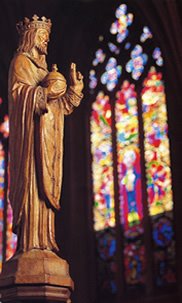
I spent years as a child attending mass at my Roman Catholic School. Each week we entered a church, fragrant with with candles and hints of incense. Before us were statues of Jesus, Mary, and Joseph, and a statue of Christ crucified, as well as a priest wearing colorful robes. Surrounding us were dazzling stained glass windows depicting numerous Biblical stories and saints and Christian symbols, much of which I did not understand...but it clearly meant something.
Later in my youth I joined a fervently evangelical Baptist Church. Many evangelical churches - especially those with roots in the Puritan and Anabaptist traditions - have mostly eschewed iconography and art...though it does have a way of sneaking in from time to time anyway.
Indeed, when the church I attended remodeled its sanctuary (about the time I moved away for college), I was pleased to see that they replaced their opaque purple windows with far more colorful and attractive stained glass windows, each with identical images of the Cross.
These two churches point toward the different approaches Christians have taken to sacred art. Some Christians (those in the Puritan traditions) have looked with suspicion on all sacred art as potential idols that break the Second Commandment, which says: "You shall not make for yourself a carved image [or 'idol']...you shall not bow down to them..." (Exodus 20:4-5).
Other Christians have pointed out that later in the Book of Exodus itself God instructs his people to build a beautiful tabernacle of Gold and fine cloth and carpentry in which to worship Him, complete with images of plants and angels and golden statues of angels as well. These Christians (including Catholics, Eastern Orthodox, Anglicans, Lutherans, Methodists, and others) have to varying degrees embraced sacred art as an important reminder of the creativity and beauty of God.
I too have come to believe that works of artistic Beauty actually have profound theological significance. You may note that this is a theme running through my recent posts since the Notre Dame fire.
Not only do I believe works of Beauty have profound theological significance, but also that they will be an important pointer to the reality of God for some who may not be swayed by Reason or logical arguments for God's existence.
I've heard that Dostoyevsky, a Christian author who wrote the profound and theologically significant novel Brothers Karamazov (among others), once said "Beauty will save the world." I think there is truth in that.
In the beginning, the Bible tells us, God created the Heavens and the earth and all that is in them. "And God saw everything that he had made, and behold, it was very good" (Genesis 1:31). The word for "good" in the Greek version of the Old Testament that was used by many of the early Churches is 'kalos' which means "good, excellent, and beautiful."
But no one who has ever gazed upon the stars, or stood on the rim of a great canyon, or watched the setting sun needs a Greek or Hebrew word study to tell them that God's creation is beautiful and that He is a wondrous creator. And note: Man was formed in God's image, which accounts for our tendency to create beautiful things as well. J.R.R. Tolkien, a devout Christian whose magnificent work The Lord of the Rings contains a great many Christian themes, quite consciously saw his work in creating a fictional world as a reflection, however small and imperfect, of the world-creating work of the Living God whose image Tolkien was created to bear.
We have a good and beautiful God who creates a good and beautiful world (though it later became distorted by sin), and he populated it with people created to bear his own image who are themselves blessed with great creativity and love to make wondrous art to the glory of God. This is why Christians across the ages have written amazing works of literature, composed lovely music, crafted intricate statues and gorgeous stained-glass windows, painted icons, built inspiring sanctuaries and cathedrals.
Even among Churches of the more Puritan traditions you will almost invariably find quite handsome pulpits and very nice leather-bound Bibles with gold-gilt page edges, and will hear lovely hymns being sung, which are all types of sacred art. We humans cannot get away from this because we are embodied creatures who are creative by nature.
Fr. Patrick Smith, an Anglican priest who was a mentor to me in college (in explaining why his own Episcopal Church put such emphasis on beauty and artistic excellence, and was willing to commit resources to them) pointed out that God certainly does not disapprove of the material world or physical beauty - in fact he created it; and in the Incarnation of Jesus Christ he brought the very Life of God into the world of material stuff, transforming it forever.
This is the theological basis for embracing sacred art.
But such an embrace of beauty also strengthens the mission of the Church as well, which brings me back to the quote from Dostoyevsky: 'Beauty will save the world.'
There are many compelling logical arguments to believe in God. Yet Beauty has a persuasive power that transcends logic and reason; Beauty has the power to resonate with us on a very deep level; beauty stirs our longing for Him who is the fount of all the beautiful things, the source of all songs and wonder. We glory in all this beautiful sacred art not simply for its own sake, but also because it serves as a pointer to Him whose life is forever a Dance of supremely Beautiful, Sacred, and Divine Love.
It is into that Triune Dance that we are called by the same Christ who is also the true Way for us to get there.
I had an experience a few years ago that powerfully brought this all together for me (again). I went with a group from the church I was pastoring to Saint Joseph's Abbey in Covington, Louisiana for a quiet retreat. Our group was invited by the monks to join with them in chanting the Psalms at their prayer offices sprinkled throughout the day.
On our last night of the retreat, a storm rolled in after we had attended Vespers (Evening Prayer) and eaten dinner. At first there was no rain, only a howling wind, and distant flashes of lightening and sounds of rumbling thunder. I decided to walk to the glorious Abbey Church rather early before Compline (Late-Night Prayer), in order to beat the rain. I found the church very dark - lit by a single candle in the sanctuary - with flashes outside occasionally lighting up the whole place. When the rain started it came down hard and loud. I sat down to pray and, after a few minutes in the quiet, turned on my MP3 player, and this is what I heard (close your eyes and imagine you are sitting in the vast, dark Abbey, with the storm raging outside):
Actually, the exact recording I heard was this one (which is even better, but has an annoying commercial before it).
I tell you, this experience was like another conversion. In that moment I felt that even had I been a militant atheist I would have been converted to faith in Christ by the sheer transcendent beauty of the experience.
Indeed the words of the repeating chorus are the traditional Ave Maria ("Hail Mary") - half of which is taken from Luke chapter 1. The other words of the more plain-chant sounding verses are also taken from the Birth narratives of Christ (such as Luke 1:38 and John 1:14). The song tells of the embodiment of the Good and Beautiful Creator God in the flesh, through the Virgin Mary, taking up residence in this material world. The song was not only about the incarnation of God in Christ in the world, but the beauty of the song, and of the Abbey where I sat, were indeed embodied, that is incarnate, witnesses to this same spiritual reality. It is hard to fully put into words how Beauty and Truth came rushing together upon my soul in those moments of meditating upon the beauty of the Incarnation of Jesus.
By comparison, the worldviews of atheism and secularism and the kind of "generic popular culture" that secularism produces is utterly incapable of producing anything like this kind of sublime experience of deep soul-stirring beauty. They can entertain, but they cannot inspire anyone with a genuine experience of transcendence; indeed, for these worldviews, there is no actual transcendent Reality beyond our own feelings. For this reason, they simply haven't the spiritual depth and mystical freight that is necessary to drive men to erect cathedrals or to inspire the writing of Mendelssohn's "Lift Thine Eyes," or to sustain our Civilization into the future.
The fact that such timeless works of art exist at all, points us to the truth that there is indeed a Transcendent reality - a Divine Logos - And that Word, that Logos, says the Christian faith, was became flesh, and dwelt among us, and his name is Jesus.
So let the people of Jesus - in word, deed, character, and work - be people of creative and life-giving beauty.
United Methodist Church Way Forward Part 5: Theologian Critiques 'One Church Plan'
When I was in seminary, my first year Greek class was taught by David Watson, who was at that time writing a doctoral dissertation on the Gospel of Mark, and was easily one of my best teachers in my time at Perkins. Today Dr. Watson is the dean of United Theological Seminary, one of our official United Methodist schools of theology, which has seen a renaissance under his leadership. Dr. Watson is a clear thinking scholar who loves the Lord, the Church, and the Word of God.
Dr. Watson has also recently published a critical piece pointing out some major problems with the "One Church Plan" that many of our bishops hope (see previous post) will be adopted by General Conference in February as a way for the United Methodist Church to preserve its institutional unity in the midst of our disagreements over how to apply Biblical and traditional authority in the church, in particular as it relates to the issues of sexuality and the meaning of Christian marriage.
I heartily encourage you to read his full post: The One Church Plan: Problems of Governance and Theology.
As I let the bishops "speak for themselves" in the last post, I'll be making generous use of quotations in this one, so that Dr. Watson can speak for himself, with some comments of my own, of course.
As the title makes clear, Dr. Watson sees two major types of problems with the One Church Plan (OCP). The first is a problem of governance. In any large and diverse denomination, there will be some disagreement among the members about almost every issue. The imperative thing for maintaining institutional unity, then, is to have a clear system for addressing these disagreements. For United Methodists, that is the General Conference. We have a clear system of authority in the UMC, but because the General Conference has consistently re-affirmed that classical teachings on sexual morality and the definition of marriage (and is likely to continue to do so under the current way of doing things), the authority that holds us together in the midst of our diversity is itself now being rejected by many Progressives and Liberals who have grown impatient with what they see as injustice in the system:
Yes, United Methodists disagree about homosexuality, but we have ways of dealing with disagreement. The threat of division is not the result of disagreement. Rather, the threat of division comes from the rejection of our processes for resolving disagreement by some segments of the church, including some of our bishops. I understand that those who have rejected our processes for the resolution of disagreement have done so out of a deep sense of moral obligation. We should be clear, however, that what we are facing is not simply a clash of ideologies, but a crisis of governance.
I believe that the Bishops, as a group, have greatly contributed to this crisis by continuously affirming as a group that they will uphold church teachings and church law, but then being apparently unwilling or unable to follow through when clergy (or even other bishops) choose to ignore church teachings as affirmed by the General Conference.
If General Conference itself can be discounted, how then can the diverse institution be held together?
The OCP's 'Local Option' offers a new approach to this problem. I wonder, after reading Watson's assessment, if he believes we are moving toward a congregationalist polity (moving us closer to how Baptists operate), and away from the connectionalism that has historically been a defining feature of Methodism:
The solution they offer changes our governance, moving some decision-making authority to local churches, individuals, and annual conferences....Noteworthy is the move toward a polity based on individual conscience, rather than on the collective decisions of the church. One might object that the OCP shifts decision-making power only with regard to matters related to homosexuality, but its basic principle, clearly spelled out in its “Theological and Biblical Foundations,” is that our deep disagreement necessitates this shift. Were we to follow this same principle moving forward, whenever there is deep disagreement at the level of the General Conference, we should simply move decision-making power to local levels.
The One Church Plan involves moving decision making authority to a more local level in the church as a way of moving forward and helping to resolve our denomination-wide conflicts over human sexuality and theological authority. I have long argued that I believe this will simply move us from an ugly fight that happens once every four years at General Conference to an ugly fight that happens every year at Annual Conference, and potentially even more frequently in the local Church. Watson agrees:
I have particular concerns about the OCP at the local church level. It specifically states, “Local churches are not required to vote. Most would likely make no changes in practice at the local level” (15). It also affirms: “This plan minimizes disruption in the local church (in most cases) and gives freedom to churches to adapt in order to minister to the LGBTQ community in context” (15). This picture of the effects of the OCP on local churches is optimistic, to put it kindly. It would only take a very small vocal minority to push for a vote in any church. Most United Methodist churches represent a diverse array of opinions about matters related to LGBTQ persons. In time, most will likely vote if the OCP passes. This plan avers that it is merciful to allow churches to debate and decide issues related to LGBTQ people internally, rather than relying on the duly elected representatives to the General Conference. I would argue that this is not mercy, but cruelty. The church I attend, like so many others in United Methodism, would be torn apart were it forced into such a decision. Shifting the locus of authority from the General Conference to the Annual Conference, local church, and individual would not resolve our disagreements or bring peace, but rather metastasize the rancor and division that so characterizes our quadrennial gatherings.
Beyond issues of governance (church polity), the One Church Plan, says Dr. Watson, raises significant issues of theology.
There are also numerous theological problems. For example, a proposed amendment to ¶105 reads, “As we continue to faithfully explore issues of sexuality, we will honor the theological guidelines of Scripture, reason, tradition, and experience, acknowledging that God’s revelation of truth and God’s extension of grace as expressed in Jesus Christ (John 1:14) may cause person of good conscience to interpret and decide issues of sexuality differently” (20, italics mine). By this rationale, our disagreement results from God’s revelation of truth and grace. How God’s revelation and grace have led us into this confusion is unclear, as is God’s rationale for doing so. Apparently, God is in fact the author of confusion (contra 1 Cor 14:33).
This is an interesting point. In the italicized sentence "God's revelation" is what "may cause persons of good conscience" to disagree. How can the Church officially affirm such a thing? Surely it is our finitude or limitations or sins that "cause" our disagreements, and not God's own revelation?
So too Watson then suggests: Perhaps a better rationale would be, “For now we see in a mirror, dimly, but then we will see face to face. Now I know only in part; then I will know fully, even as I have been fully known” (1 Cor 13:12, NRSV). In other words, in our human brokenness and finitude, we may not be able always to perceive God’s truth with clarity. This would mean, however, that some people in our denominational debate have perceived God’s will more clearly than others, which the OCP is loathe to concede.
That some people are right and others are wrong is a concession that the OCP is not willing to make, but logic demands that it is clearly true in this case:
If there is a God who did indeed create marriage for his own purposes,
Then it cannot follow logically that our mutually-contradictory interpretations of what marriage means are both correct and both equally in harmony with the one Divine Will. Such an assertion runs contrary to Reason.
Watson then goes on to note that the OCP document does not offer a theological rationale for its new revised definition of marriage, which means it could be an unstable definition resting (potentially) shifting sands. What if, for instance, advocates of "open marriage" begin to assail the revised definition, if there is not a theological and Biblical rationale for why marriage must be monogamous?
While the promoters of the One Church Plan have described it as "generous" in allowing people with differing interpretations to stand together in unity, Watson does not believe that the OCP actually creates the "Neutral Ground" that it claims to make:
It is important to note that the OCP implicitly affirms same-sex marriage. By eliminating the stipulation that marriage is between one man and one woman, we are not simply creating space for a broad range of positions. We are implicitly stating that we recognize the validity of gay marriage as a denomination, even if some members of our denomination do not agree with our doing so. In other words, we have a case of addition by subtraction. Crucial to this point is that there is no local option attending the redefinition of marriage. It is a redefinition for the entire denomination. Committed traditionalists should not be happy with this.
Yet the OCP also allows clergy, local churches, and Annual Conferences to reject and even prohibit same-sex marriage and the ordination of self-avowed, practicing homosexual people. Following the line of argument that progressives have made since the earliest days of our denomination, this is simply the continuation of a longstanding pattern of discrimination. It will allow United Methodists in some areas to act in ways that progressives have long claimed to be unjust, bigoted, hateful, and harmful.
All this is to say, the OCP does not create a neutral ground where all can stand in unity. Rather, it offers us a picture of the church in which the way we understand and practice marriage just is not all that important. Those who do think our understanding of marriage is a crucial part of our life together – those who hold deep theological and ethical convictions about marriage – will never be satisfied with this proposal.
Finally, Watson criticizes the way the One Church Plan document deploys the language of 'religious liberty'. Long time readers of this blog will note that I have, along with many Libertarians, long been an advocate of addressing some hot-button culture war issues in the United States at the State and Local levels whenever possible, instead of forcing upon us a one-size fits all approach from the Federal Government which inevitably does not take into account the very real differences in cultures among the states.
Some may find it odd, then, that I oppose moving decision making about how the church will handle some of the same theological issues to a more local level. But the difference is rooted in the vast difference between a nation (into which you are born, and which has the power to compel you to obey its laws - even by using physical violence) on the one hand, and a Christian Church on the other, which one freely joins on the other. Watson explores this same issue in the final section of his piece:
Religious liberty is a notion at home in the sphere of civil government. It protects religious groups and individuals from restrictions and interference by the government in the expression of their beliefs and practices. As an ecclesiological concept, religious liberty is as out of place as a pig in a rose garden. Churches are communities of faith and practice. In the United States, joining a church is, in and of itself, an expression of religious liberty. The decision to order one’s life in keeping with the teachings of the church is also an expression of religious liberty. Such liberty is necessary so that people of faith can live out their convictions in a society that does not always share those convictions. But should people of faith be protected from the convictions of the communities of faith they have freely chosen? The use of “religious liberty” in the OCP betrays a deep confusion about the difference between a church and a civil society. This confusion, moreover, runs through the entire plan like a foundational crack that will eventually result in the collapse of the entire structure.
To be honest, I am not entirely sure what the best way forward is for our denomination. I do believe, however, that the OCP is too deeply flawed on too many levels to move us forward in faithfulness and integrity.
I appreciate Dr. Watson's tireless work to revitalize the church and its theological education (much-needed work that has borne some fruit already), as well as is less-well-known work to make the church more accessible to individuals with disabilities and learning disorders. I hope people will consider well what he has written. Again, the FULL Article is HERE.
In my next article, I will offer my own concerns about the One Church Plan and my assessment of the other two plans as well.
For those who are interested, I want to share over the coming weeks and months a few articles and analysis pieces from various United Methodist leaders over the possible fall out of General Conference 2019 and the possible future(s) for our denomination.
This post serves as an introduction to what has been going on and links to the first article I think is worth reading on the topic (so, if you already know what is going on in the UMC, feel free to skip down to "What do the experts say" below to find the recommended link). WHERE ARE WE NOW, AND HOW DID WE GET HERE?
First, a review. The United Methodist Church has come to a point of serious disagreement and division over some of its official teachings in the area of sexual morality, and how to appropriate the Biblical teachings upon these issues (and others as well).
What does the Church officially teach in its Book of Discipline (the book of official teachings and church law)? The United Methodist Church understands that all people are created in God's image and therefore have "sacred worth" and that the church is to be in ministry with and showing love toward all people, including LGBTQIANP+ individuals. The United Methodist Church believes that homosexual practice* is incompatible with Christian teaching, and understands marriage to be a union of one man and one woman. Sexual relations are only affirmed within this Bible-defined marriage union. The United Methodist Church also supports laws in civil society defining marriage as a union of one man and one woman.
The church also teaches that, while abortion may be a legally accepted medical practice in rare emergency situations, "we are equally bound to respect the sacredness of the life and well-being of the mother and the unborn child." The life of an unborn baby is morally equal to that of an adult mother, both bearing the image of God, which obviously means that we reject abortion as a means of birth control, which constitutes the great vast majority of all actual abortions.
On all of these issues the Church's teachings have become controversial because they run directly counter to some of the popular teachings of our American popular culture.
Accordingly, some within the church have called for these official teachings to be reversed or dropped from the Book of Discipline. Progressives have suggested alternate ways to interpret the relevant Bible passages so that they do not mean what they appear to say or, in other cases, progressives have simply suggested that the relevant Bible passages only address 1st Century concerns and are indeed not relevant or applicable to the issues at hand in our contemporary culture, whatever those passages may say. This latter move involves a re-envisioning of how Biblical authority "works" that, most traditionalists argue, is quite different from what we have inherited from the traditions of the universal Church, and particularly from our Protestant and Wesleyan heritage.
Every four years the General Conference of the Church meets, which alone has the authority to change church teaching. So, for some decades now, the fight over sexual morality has become increasingly visible, and increasingly shrill at each successive General Conference.
In addition, a number of clergy and even some bishops, have signaled that - despite their ordination vows to uphold our church law - they have no intention of living according to rules that they see as unjust discrimination. A WAY FORWARD?
At the 2016 General Conference it was clear that an impasse had been reached and there was serious discussion about the possibility of a formal split, or schism, that would divide the church between more traditionalist and more liberal groups.
To avoid such a split, the General Conference (responding to a request of the Bishops) tabled all discussions related to human sexuality so that the issue could be referred to a special Commission on the Way Forward, that would make proposals to deal with our division over this one issue.
The Bishops' Commission on a Way Forward has met over the past 2 years and has developed 3 proposals for the Way Forward. A special General Conference has been called for Feb. 2019 to consider these proposals. The General Conference could adopt any one of the proposals, or revise one, or craft a totally new proposal for adoption, or indeed choose to take no new action at all.
The three proposals will be discussed in detail in the articles and posts that I share. In short they are:
1) The Traditionalist Plan - maintain current church teachings, strengthen accountability for clergy and bishops who break their vows;
2) The "One Church" Plan (i.e. "Local Option") - remove the church's historic teaching and allow each pastor, congregation, and Annual Conference** to set their own policies on whether the pastor will officiate or the congregation will host same-gender union ceremonies and whether the Annual Conference will ordain individuals living in same-sex relationships;
3) The Connectional Conference plan - the most complicated plan involves creating 2 (or 3) super "conferences" with which individual Annual Conferences and/or congregations could then affiliate. One of these super conferences would be traditionalist and one would be liberal (another might be in between); each would set their own standards for ordination, but would jointly share the stewardship of things like UMCOR (our disaster response ministry) and the clergy pension program, the Publishing House, and the like.
What the General Conference chooses will have profound implications for congregations (who may at some point have to choose a new group to affiliate with), and clergy families (whose callings, careers, retirement plans, and so on will be affected), and denominational institutions (and their employees) such as seminaries, universities, children's homes, and mission organizations and so on, that may be divided or merged or eliminated.
SO, WHAT DO 'THE EXPERTS' SAY WILL HAPPEN?
Of course, we are all prayerfully waiting to see what will happen in February.
I have a few thoughts of course, but I'd like to share the thoughts of people better-informed that myself.
Rev. Lynn Malone is no stranger to General Conference and has shared his thoughts HERE. Rev. Malone is exactly right, in my view, that choosing any of the three plans will certainly result in more division and pain, and he highlights the real possibility that the 2019 General Conference chooses to do nothing at all. That, in my view (and his), would be a catastrophic error, but some believe that it is the most likely outcome.
==================================================== * Note that the church's teaching only addresses homosexual practice, meaning outward behavior, not homosexual desires or the people who feel or experience those desires ** The Annual Conference is roughly equivalent to the Diocese in Anglican and Roman Catholic Churches, it is the basic unit of the United Methodist Church, which connects all of the local congregations within a geographical region; for example, all of the churches in Louisiana form one Annual Conference. The Annual Conference, not the local congregation, is the body that approves and ordains candidates for vocational ministry
One of the things I've noticed as I've read more of John Wesley over the years is that he frequently makes lists of the "fundamental" or "basic" beliefs that go down "to the root" of Christian faith and Christian living. Not all of his lists of the 'basic' teachings are exactly the same, but they all cover the same great themes of Creation by God, the Fall of Mankind into Sin, and the Redemption through Christ. This is the heart of Wesleyan (and all Christian) faith.
Unlike some traditions (such those stemming from Medieval Scholasticism), Methodism has never attempted to have an official answer to every possible theological question that every good Methodist is expected to believe; there has always been a degree of diversity, but beginning with Wesley it has been recognized that we must have unity on the basics if we are to live and work together.
Over the last several generations, while we increasingly do give lip service to the Wesleys and the other major lights of our theological tradition, we United Methodists have very often attempted to embrace doctrinal pluralism in the name of "inclusivity." We (rightly) want to include as many people as possible within our church, but rather than trying (like the early Methodists) to teach all of these diverse people the same basic beliefs, we have downplayed the importance of beliefs or doctrine altogether, embracing (with a shrug) a sort of "anything goes" attitude, saying things like "it is not what you believe that matters, but how you live."
Ultimately, however, I believe this approach is self-destructive, especially to church unity. How we live is necessarily related to what we believe. How we live together is necessarily related to the beliefs we hold in common.
How can we indeed walk together if we are walking in different directions, following different guiding lights?
This is the major point of an excellent new post by Dr. David F. Watson.
Dr. Watson was my Greek teacher in seminary at SMU, and is now dean of United Seminary in Ohio. I encourage you to read it in full at the link above; below are some highlights from his piece (in bold), with my own comments.
Watson argues that if we are to think, feel, and finally live as Christians, we simply cannot get away from "doctrine" (that is, official teachings). Dr. Watson writes: The Christian mind is necessarily doctrinal. Without an understanding of proper teaching about God and what this God has done for us in Jesus Christ, it makes no sense to talk about a Christian mind at all. We may claim to love God, but who is this God whom we love? Why do we love God? Why should other people do so? How do we know any of these things? The answers to these questions don’t just shape what we believe, but how we live.
The attempts to neglect or reinvent Christian doctrine - particularly, I would argue, in the seminaries and ivory towers of academia - are largely responsible for the massive degree of division that now exists within the Historic (often called "Mainline") Protestant churches, almost all of which have seen major schisms in recent years. The "publish or perish" approach to scholarship that now dominates the Academia of the Western World, by its very nature, rewards innovation rather than the passing down of the time-tested faith that has been received.
Dr. Watson expresses well why this constant need to innovate and revise has led to dis-unity in the church: We build upon the beliefs of those who came before us. We honor their work, their lives, and sometimes their martyrdom. Though many have succumbed to the temptation to try to reinvent the Church’s faith based upon foundations more palatable to the modern or postmodern mind, these attempts have been unable to sustain the Church. They have neglected the wisdom of the ages. The end of such revisionism can only be division. If each culture, each era, each philosophical movement reinvents the faith on its own terms, Christian unity is impossible. True Christian unity can only come about when we share common beliefs about the nature of God, human life, and salvation. If we continue to de-emphasize doctrine in our faith communities, we will continue on the painful road of denominational fragmentation.
Dr. Watson goes on to lament the lack of serious attention to doctrine in the Historic Protestant churches, noting the contradiction that necessarily results from this neglect:
The Christian mind requires doctrinal formation, and in mainline Protestantism, we have most often avoided this. We have chosen to focus on forming our congregations into socially just people who will live in socially just ways, but without teaching them how we might reach conclusions as to what constitutes just behavior. We are supposed simply to know right and wrong intuitively. If the 20th century shows us anything, however, it is that right and wrong are not things that human beings know intuitively... Our thoughts are disordered, and we need guidance. Teaching the faith once and for all handed on to the saints is a step toward the proper ordering of our minds.
We all call ourselves "Methodists", and we do have a standard liturgy and a standard set of doctrinal commitments. As I see it, this is a bit like all the restaurants in a chain sharing the same recipes for their meals: You know what you are going to get based on the name of the restaurant. Otherwise there would not really be any point in branding them all the same, would there? If one KFC served fried chicken and the next served Italian food, what would be the point in calling all of them KFC and giving all of them the same logo? It would be a meaningless moniker that would only confuse people. The same happens to Methodism (or any denomination) when we neglect the official teachings (and the basic liturgical praxis) of our church.
Because of this neglect, United Methodism has now come to the very brink. There are serious discussions about how to divide up the denomination. The next 5 years will be decisive in the history of our denomination (and whether that denomination continues to exist in its recognizable form).
I fully agree with Dr. Watson that there is really only one way to Christian unity: to recover, embrace, hold-fast, celebrate, and actively teach "the faith once delivered to the saints" (Jude 3), the faith of the one holy catholic and apostolic church that she has learned from listening to the Spirit speaking through the Bible over 2000 years, the faith that is focused upon the person and work of Jesus Christ.
This Classic faith, this classic way of understanding the Bible, is in fact already clearly expressed in our doctrinal standards (including the writings of J. Wesley), our liturgy, in the creeds and the lectionary, in our hymnody, and so on. The question is whether we will trust these grand resources of the Great Tradition to help us rightly receive and live the Biblical faith (as I have tried throughout my ministry to do, in keeping with my ordination vows), or whether we will continue to neglect them and hope that goodwill is enough to hold together a body of people with disparate beliefs.
As William Abraham, another great United Methodist theologian (and teacher of mine at SMU) puts it, we need to "wake from our doctrinal amnesia" if we are to move forward in faith together.
In the liturgy for the consecration of bishops in our Book of Worship, the ministry of the bishop is described (in part) as follows:
"You are called to guard the faith, to seek the unity, and to exercise the discipline of the whole Church; and to supervise and support the Church's life, work, and mission throughout the world."
The idea that bishops are the primary guardians of the faith and unity and ordered life of the church is not a Methodist innovation, but has been inherited from the ancient and ecumenical church. And yet in recent years more and more bishops have undermined the unity and the faith of the denomination by putting their private agendas, opinions, and goals above the common and historic teachings of the church. Examples range from Bishop Sprague who very publicly denied the Resurrection, Virgin birth, atonement, and the Deity of Christ to Bishop Talbert who has now repeatedly officiated at same-gender civil 'marriages' in direct contradiction to the very Discipline and Covenant that all of our bishops vowed to uphold at their consecrations.
In these instances many spoke out calling for accountability, while some other bishops and clergy stood by silently doing nothing, or in some cases even cheered these acts of infidelity.
People have been wringing hands for years - and especially in the last couple of years - over the unity of The United Methodist Church, asking if the denomination will split.
I believe that unity and relationship is always based upon trust. According to the classic Protestant teaching of justification by faith (affirmed by Methodists) it takes faith - that is, trust - for me to be in right relationship with God. Indeed it truly takes trust for me to be in a healthy relationship with anyone else. How can a wife have a good and life-giving relationship with her husband if she thinks he is cheating on her - if she doesn't trust him? The answer is that she cannot.
How can we work side by side in common mission if we do not trust one another? How can we follow the missional leadership of our bishops if we are suspicious of their motives? We obviously cannot.
There is a crisis of trust in The United Methodist Church right now that is a direct result of the kinds of actions mentioned above and the "mixed signals" coming from other leaders in response to these actions.
If the denomination does split it will be because we simply no longer trust one another.
There is only one way that trust can be regained, and it is simple: practice honest. Let your "yes" mean "yes" as the Lord Jesus says. Do not make a rash vow to God you do not intend to keep as the Book of Ecclesiastes says. Simple honesty and integrity is the only way this crisis of trust in our church will begin to heal.
If bishops and other officials will simply uphold their vows, keep their promises, and do those things that they swore an oath to do (regardless of their own personal opinions) it will go a long way toward rebuilding trust. If they do not - if they find some rationalization for breaking their promises to the covenant community - then I believe a breakdown of the covenant that binds us together (and thus, a denominational break-up) is inevitable.
One of our most outstanding and godly (as well as scholarly) bishops these days is Scott Jones. He has written a frank and much-needed post on this very issue. Here is the opening section (read it all HERE):
During the last four months, I have had multiple invitations to break my vows. Many people have suggested that, in the name of protesting against perceived injustice, I should disobey the discipline of The United Methodist Church and violate the sacred promises I have made at two key points in my life — ordination as an elder and consecration as a bishop.
I decline those invitations.
I will keep my promises.
I will be faithful to God’s calling on my life as a leader in our church.
Because American culture so little values obedience and discipline today, and because too many persons in the UMC are following the culture in this direction, it is important that I explain why such a refusal to participate in disobedience is the right course of action...
I enjoy reading the 'Conciliar Anglican' blog now and again; it is the place to go for thoughtful posts from an Episcopal priest deeply rooted in the ancient orthodoxy ("true and right belief") of the universal ("catholic") Church across the ages. In this recent post he engages with the always provocative G.K. Chesterton on the virtues of firm doctrinal boundaries (much maligned by certain members and even leaders and bishops of the historic Protestant Churches these days). Read the full post HERE.
I am convinced that the recovery of firm doctrinal boundaries is a key to the renewal of Christianity in our culture. Not that the Church needs or must have a hard and fast rule or teaching on every possible issue - that kind of rigidity leaves little room for thinking through the implications of our faith; yet on the other hand an indifferent "anything goes" attitude towards Christian teaching and Biblical (mis)interpretation - which has prevailed in some circles of historic Protestantism - leaves churches with no identity, no message, and therefore no relevance, no prophetic challenge, and no gospel consolation for the world around us.
I am one who finds such boundaries exactly where they've always been: in the historic catholic creeds (such as the Apostles' and Nicene Creeds) and in the doctrinal standards of my own denomination. The above statue of Chesterton is in the quaint town of Ponchatoula in my home state of Louisiana. How it got there, I know not, but I think it is great.
Back at the 2004 General Conference, it came to light that some conservative leaders were discussing the possibility of bringing forward a proposal for "amicable separation," splitting the church along liberal-conservative lines so as to finally (presumably) end the bitter arguing over sexual morality within the church and get on with the mission. When the proposal became public, many people (including other conservatives) denounced the idea of schism, and the General Conference passed a resolution stating that we remain United Methodists.
Fast foward a few years. General Conference 2012 saw a very well funded, very organized, highly vocal and strategic effort by progressives to liberalize the church's position fall short of its goals by even larger margins than in the past, despite comparatively low key efforts of conservative groups. Why? The demographic realities are becoming clear to everyone. The areas of the church in the US that are growing (or simply "not-shrinking") mostly tend to be in the more theologically and socially conservative areas of the Church; the fastest declining parts of the Church tend to be in the more liberal/progressive areas, but everything happening in the US is really small potatoes compared to the massive growth in the conservative overseas regions, in Africa and Asia especially. The representative membership of each future General Conference will reflect these demographic shifts toward the moderately conservative American South and toward the even more conservative Global South.
Because it looks highly unlikely that The United Methodist Church will abandon historic Christian teachings and Biblical interpretations on sexuality anytime in the next century we are now beginning to hear calls from progressive/liberal United Methodists for exploring an 'amicable separation' of the church. Consider this piece by Rev. Jack Jackson, a young professor at Claremont seminary.
In his article Rev. Jackson asserts that progressives/liberals have essentially 4 options:
1) Continue to live under the current Discipline while hoping for a change that is increasingly unlikely,
2) leave the denomination for a more liberal one,
3) "ecclesiastical disobedience" (he actually uses the somewhat misleading appelation "civil disobedience") or
4) begin a conversation about a denominational split
He notes that, while both conservative and liberal members have opted for other churches more to their liking (and continue to do so) because of endless fighting, we have in recent months seen a couple of liberal/progressive bishops and Jurisdictions calling for ecclesiastical disobedience (many of us are eager to see if and how the Council of Bishops will address this at its fall meeting, going on now). But Jackson asks a wise question: what is the ultimate goal, what is the "end game" for that strategy? To somehow force progressive/liberal views on an traditionalist majority that does not accept or believe in them (all in the name of 'justice')?
Surely even a few moments of consideration can make clear to everyone that ecclesiastical disobedience (and, indeed, calling the position of the majority of Methodists 'evil') is not likely to help us remain in communion, or even dialogue, with one another. Jackson quite rightly asserts that many traditionalists will not remain in the UMC if it reverses course on sexual issues (especially, we might add, if the decision to do so looked to have been somehow manipulated by a vocal minority). He suggests that if even 10 percent of the active US membership left the denomination over a short period of time in response to a liberal turn on this issue, this would wreak financial havoc upon the structures of the remaining Church to such a degree that shrinking liberal/progressive jurisdictions simply could not have the resources to cope with it. That assumes only 10% would abruptly leave, suppose it was much more?
So Rev. Jackson now advocates option 4: splitting up the church. It seems there are some potential benefits: we might end up with two remnant churches (I'll call them "The Progressive Methodist Church" and "The Methodist Episcopal Church") each better able to clearly articulate their identity, beliefs, and mission than the UMC is now able to do; however I think such a split would further underline the serious ecclesiological deficiencies that seem "built into" Protestantism. It seems we heirs of the Reformation simply cannot "maintain the unity of the Spirit in the bond of peace" as the Lord, through Scripture, commands (whether the Roman or Eastern churches do it better is an open question worth exploring). I don't claim to know what the best way forward is for The United Methodist Church at this moment in our history. Considering our debilitating impasse, it looks to many as if schism is ultimately inevitable, be it a formal schism or simply a drifting away of individuals (the 'personal schism' of option #2). As things are now, the distracting in-fighting continues to drain our energy and scatter our attention and hurt our church.
So I do not claim to know the best way forward, yet still, I know that Jesus prayed (as I do) for unity among all his followers.
The Coptic Church (based in Egypt) has chosen a new patriarch or pope this week. In the Coptic selection process, the church prepares a "short list" of three candidates and then, in a ceremony at St. Mark's Cathedral in Cairo, a blindfolded boy (believed to be guided by the hand of God), selects one name at random. For me this is reminiscent of the selection of Matthias to replace Judas in Acts Chapter 1. I kind of like the way that the process deliberately leaves room for the Holy Spirit to surprise everyone, while the shortlist ensures that wise and prayerful discernment by church leaders is also a part of the process (it is not completely random). See the video below.
The Coptic selection process makes an interesting contrast to the process by which the Anglican Communion (based in England) chooses a new Archbishop of Canterbury to lead the communion. For Anglicans a Crown Nominations Committee meets and selects a first and second choice candidate from among the English bishops whose names are then passed along to the Prime Minister and Queen of England who confirm one of the candidates (the first choice, unless some serious reservations about him arise). However, the Anglican process is currently bogged down as the committee - divided along progressive/liberal versus traditionalist/evangelical lines - has not been able to agree on two names.
We United Methodists, on the other hand vote at the local level (Annual Conference) for delegates who vote at a larger Regional level (Jurisdictional Conference) for bishops. The bishops themselves elect a president of the council of bishops from among their own number. There have been proposals for elevating the president-bishop of the United Methodist Church to a more prominent position that would be elected by General Conference.
Speaking of picking leaders and speaking of bishops there are a couple of significant things happening this week: A Presidential election here in a sharply divided and uncertain USA and a also meeting of The United Methodist Bishops - the first such meeting since new bishops were elected this summer and since some bishops have called upon liberal clergy to disregard the Discipline of our Church where they disagree with it. Many of us hope the bishops will address this potential crisis.
Given the big issues of these days and the great need out nation and our churches have for good leadership in troubled times, let us pray for wisdom for our nation's voters, for our current leaders, and for our church's bishops (and, indeed, for the Crown Nominations Committee).
No doubt there will be much discussion and debate of sexual morality at the General Conference over the next few days. Four years ago, some called for the church to simply adopt no official position at all, but "agree to disagree" on sexual issues. At first glance this seems an aftractive option to many. Here is a commentary from Good News Magazine that examines the merits and problems of "agreeing to disagree."
On Oct. 21st (about 3 weeks ago), in honor of his 80th birthday, Christianity Today re-ran an interview with Thomas Oden from September 1990. Oden has been a significant influence on me, especially in my seminary years through his books such as Agenda for Theology, Rebirth of Orthodoxy, and his massive ecumenical Systematic Theology in which he advocated giving much more attention to the ancient ecumenical consensus in theology and Scripture interpretation as we post-modern folks try to hear and understand the Biblical message for today.
Oden's "return to the early fathers/ancient consensus" project has often been called "Paleo-orthodoxy" (to distinguish it from 20th-Century's "Neo-orthodoxy"), though it really is just "orthodoxy" in the broadest sense. The interview was conducted by Christopher Hall, who is now a leading paleo-orthodox theologian in his own right. Some highlights from the interview are copied below, the whole article can be found here.
In place of modernity you call for "a careful study and respectful following of the central tradition of classical Christian exegesis." In other places you call this orthodoxy. What is orthodoxy?
Lancelot Andrewes, a sixteenth-century Anglican divine, stated the answer as memorably as anyone, with a five-finger exercise: "One canon, two Testaments, three creeds [the Apostles', Nicene, and Athanasian], four [ecumenical] councils, and five centuries along with the Fathers of that period," by which he meant the great doctors of the first five centuries: Athanasius, Basil, Gregory of Nazianzus, and John Chrysostom in the East; and Ambrose, Augustine, Jerome, and Gregory the Great in the West.
Do you see the Holy Spirit involved in that process?
Each of these creeds, councils, and teachers confessed that it was the Holy Spirit who was forming the consensus about orthodoxy and heresy. The council definitions were not something externally imposed on the church. They emerged only to define the already prevailing general lay consent to apostolic teaching.
You would say the formation of the Canon cannot be separated from the work of the Holy Spirit.
Exactly. The Spirit guides us to all truth. The Spirit helps us to remember. It is the Spirit who both calls forth the written word and guarantees its accurate transmission. The notion of canon is impossible to conceive without the premise of the Holy Spirit's activity. God the Spirit not only enables the Canon but calls forth the community to affirm and transmit the Canon.
What would you say to someone who claims, "I've got the Bible. I don't need church history or systematic theology"?
We would not even have the Bible without its reliable transmission, which is another way of talking about the work of God the Spirit. Orthodoxy understands that God is at work in the body of Christ to form that body in history, awaiting God's own coming in the return of Christ. Christ promised the early church the Spirit, who came on the first Pentecost and continues to dwell in the lives of the faithful. He promised that the Spirit would abide with this community, guide it, lead it to all truth, and help it recollect the words of the Lord. This is just what has been happening for the 20 centuries since the ascension. We're moving in the wrong direction when we say individualistically, "I've got my Bible; I don't need anything except these words." Protestants now need to recover a sense of the active work of the Spirit in history and through living communities. Our modern individualism too easily tempts us to take our Bible and abstract ourselves from the wider believing community. We end up with a Bible and a radio, but no church.
You have told about a dream in which you were walking in the New Haven cemetery. You came across your own tombstone and the epitaph read, "He made no new contribution to theology." Were you happy or distressed to read that?
In my dream I was extremely pleased, for I realized I was learning what Irenaeus meant when he warned us not to invent new doctrine. This was a great discovery for me. All my education up to this point had taught me that I must be compulsively creative. If I was to be a good theologian I had to go out and do something nobody else ever had done. The dream somehow said to me that this is not my responsibility, that my calling as a theologian could be fulfilled through obedience to apostolic tradition.
In reflecting on the lectionary's Gospel text for this coming Sunday (Matt. 16), which speak of the authority of the apostles (Peter in particular as their leader) to "bind and loose," I have been reflecting a bit on the "authority" of the church leaders.
Having spent plenty of time around Christians who are young, individualistic, evangelical/"low-church", or emergent/ing/ence, I've certainly run across plenty of complaints against the "clericalism" of the historic churches. Sometimes this issue of clericalism has come up in conversations surrounding our current attempts to streamline some parts of The United Methodist Church's organization as well. It can seem quite silly at times how dependent the gatherings of Christian believers are upon the ordained clergy in our tradition (and it is even more the case in some other traditions).
Some United Methodist bishops, rather than calling for less clericalism have instead been calling for better clergy: they are constantly emphasizing how 'excellent' (perfect?) our clergy must learn to become and perform in every aspect of their work from vision-casting and leadership and pastoral work and preaching and teaching and evangelical outreach to community-forming and so on...if we are to lead the church into renewal. It seems a great deal of pressure upon our humble and imperfect shoulders (though if some of the stories I hear are true, it seems we do have plenty of room to improve our ranks of clergy).
Others (even other clergy!) have simply wondered why we should have an ordained clergy at all, appealing to a vague broad stroke image of an early church with no ordained clergy, but only a very loosely organized gathering that exudes some vague sense of "community" that is difficult to nail down - difficult because the mental picture is, after all, an imaginary one. Such appeals often don't have detailed Biblical exegesis or appeals to the Christian tradition - the reasoning and experience of the whole Spirit-led Church - ready at hand to support their picture of a clergy-less church. Mostly likely they have in mind the notion that "we are all priests after all" based upon 1 Peter 2. And some Christian groups (such as the Amish) have no clergy at all.
Sometimes I sympathize just a bit with these anti-clerical clergy, but the more I think on it, the more it seems that many of our problems I see arise not from having an ordained clergy per se, but from trying to maintain an professionalized clergy - with the expense of top-notch (read: expensive) graduate schooling (seminary), health insurance, benefits, pension and retirement plans, and so on. These sorts of things were certainly unheard of in the Biblical church and should perhaps be seen as optional. What we certainly do have set forth in the Bible is a well-educated clergy (but, perhaps informally so, as with the training the disciples received by travelling with the Master); a clergy who were ordained and comissioned through the laying on of hands of established church leaders (see Acts 6 & 13; 1 Tim. 3 & 4; Titus 1 etc.), who also made some or all of their living as clergy (see 1 Cor. 9:14). Indeed such ordained leaders are a gift from God (see Eph. 4).
As an aside, if all your impressions of the clergy came from watching recent films, you might think it absurd to call them a "gift" from God - or so I reflected while recently re-watched "The Kingdom of Heaven" (starring Liam Neeson, Jeremy Irons, and Orlando Bloom) in which the clergy are universally wicked and disgusting characters. Anyways...
We could have some debate as to whether there is any sense in which the authority to bind and loose given by Jesus to the Apostles (Matt. 16 & 18) or the authority to forgive or withold forgiveness of sins (John 20) was also passed along by the apostles to subsequent church leaders: the elders and bishops and deacons, from the early church down to the present day. I believe the answer is 'yes' - again, as a gift from God.
All of this came together as I was reading a John Keble sermon today (one of the great theologians of the Oxford Movement seeking to recover the ancient and catholic roots of the Church of England) in which he addresses the "all believers are priests, so can't we just do church without them" objection to maintaining an ordained clergy (nevermind that such an objection needs to do business with the passages already cited). Here is what Keble says:
"Yes, brethren, we are all kings and priests because we are all members of Him who is the true King and Priest. We are kings to rule over our own wild passions and fancies; we are priests to offer ourselves, our souls and bodies, a living sacrifice to God, and to join in offering the Church's perpetual sacrifice which is her Lord's Body and Blood. But this hinders not but that there should also be among us an especial order of men whose business it is to govern the Church in His name and to offer up to His Father His appointed memorials: to bless us and to intercede for us. The Jewish people were called by the Lord on Mount Sinai, "a Kingdom of priests and a holy nation" (Ex. 19:6) yet they had special kings, as David, and priests, as Aaron, on whose office no one might intrude. As St. Paul, speaking of the priests' office, says to the Hebrews, "No man taketh this honor unto himself, but he that is called of God, as was Aaron" (Heb. 5:4). And we know what fearful things happened to Korah and his company, who set themselves up as if they might be priests as well as Aaron...The whole Church, both Jewish and Christian, were to be priests, yet the outward work of priests was always to be done by persons especially ordained for it." (from Keble's "The Church Apostolic" - Volume 6, Sermon 18).
On the other end of the spectrum from those Christians who, seeking a 'holy egalitarianism,' would prefer no clergy or officers in the church at all are those who are always relishing in the heirarchical ordering of things (in my personal experience, these folks are Roman Catholics by-and-large). While I may not subscribe to all the particulars that these other folks may embrace, the Bible clearly does envision a God who brings order to chaos, and has a plan for the right ordering of all of his Creation. It seems reasonable then to expect that the Church, as the community under the headship of Christ the King - being the community that holds forth the promise of the New Creation to the world, would also be a community with a particular kind of order to its common life and its leadership that somehow points to God's larger plan.
Since the earliest days this took the form of a community gathered around a bishop who alone had the authority either to lead the people to the Table of Communion with Christ and with his Body, or to ordain others (presbyters) to do so (and deacons to assist as well). So there is one more reason to believe that this sort of ordering of the church reflects the will of Christ and his Father.
No doubt this conviction that God brings a particular sort of order to his people on earth is why the issue of church polity - how a church is organized, what kind of leadership structure it conforms to - has been of such critical importance to so many Christians throughout history. No doubt many of my fellow American Protestants may feel somewhat bewildered by the passion attached to some of these historic debates on Church polity: we Methodists have been particularly apt to judge and swiftly alter any aspect of the Church's life - including our ordained ministry - more on pragmatic grounds (does it work?) than theological grounds (is this consistent with our understanding of God and his purposes?). But that is not to our credit, I think.
So do we need ordained clergy? If we believe that we truly need the ordering of our lives and the lives of our churches to conform to the good and beautiful order that has been established by God and revealed through Holy Scripture, and written into the fabric of his ancient covenants and the New Creation that he is bringing into the world, then our answer is Yes; the ordained offices are a beautiful gift from God.
Now if we could just figure out how he wants them to function...
(pictured above, my own bishop, William Hutchinson, preparing to ordain a couple of elders/presbyters a while back).
Every now and again among Methodist bloggers there develop some good discussions or commentary about whether or not to wear a clerical collar, which is optional for all United Methodist clergy (as an Anglican priest John Wesley, as pictured below, always wore the 18th Century version of the collar).
I've been in an ecumenical ministry for the last four years in which I did a good deal of preaching and service-leading in Episcopal and Presbyterian (and even some Methodist) congregations that were accustomed to or familiar with a collar, and I certainly wore one on these occasions, though not generally on a typical day.
As I transition into a regular parish ministry this summer, my plan is to wear the collar each Sunday and perhaps whenever I know I'll be making hospital calls, though not on a daily basis. As I've said before I do think there are good reasons to use things like a collar, or vestments, and other visual connections with our historical 'rootedness' and 'catholicity' as United Methodists (even in services with "contemporary" music - the two are not at odds).
In a recent piece at his Closet Anglican blog, United Methodist pastor Tim Powers discussed his reasons for wearing the collar. He raises some good points, and also addresses some concerns that pastors may have when considering the collar. One thing that he says that really stuck with me was this:
So many people wear cowboy/girl clothes or all black or tattoos and pierce themselves in an attempt to "wear their stories." I would much rather wear God's story.
A pastor once told me he didn't wear a collar because "people look at you differently if you do" - but, I suppose that is the point: I like seeing clergy around town wearing collars because is that it is visible reminder to everyone (including the clergy themselves) that something weird is going on: there really are people - quite a few - whose lives have been radically grasped by the true and living God. And that is a story they wear, becoming almost "icon-like" as they go through their days.
The turmoil of the Anglican Communion has been so complex in recent years that I've blogged on it less. Here is a very simplistic overview:
In 2003, The Episcopal Church (in the USA) made an openly practicing homosexual man a bishop, contrary to the teachings of the Bible, the Christian tradition, and the Lambeth Conference (when every Anglican bishop in the world meets every 10 years or so).
This innovation caused massive turmoil and friction within the Anglican Communion, with several American dioceses defecting from the Episcopal Church altogether and coming under the provincial supervision of other, more orthodox, Anglican provinces (national churches; mostly in Africa and South America). A number of provinces of the Anglican Communion declared themselves to be in impaired or even broken communion with the Episcopal Church.
In response to this crisis and to avoid an all-out schism, Anglican leaders began developing a "Covenant" that would bind the various provinces of the Communion more closely together and would provide mechanisms to deal with Communion-wide disputes in the future.
In the meantime, matters have been complicated further as the Anglican Church of Canada has moved forward in developing rites to bless and celebrate life-long homosexual unions (while being very careful thus far not to call them "marriages") and the US church has recently elected a second bishop living in an openly homosexual lifestyle.
The Lambeth Conference of 2008 met with Archbishop of Canterbury Rowan Williams (pictured right) presiding, but was content to discuss these matters and engage in a listening process, rather than making any judgements or declarations. However, a large percentage of the more orthodox and traditionalist bishops did not come at all in protest. These no-show bishops, along with many who did attend Lambeth met together later that year at the Global Anglican Future Conference (GAFCON) in Jerusalem, which issued a statement of fundamental Anglican beliefs and values.
At this point, the Covenant document has now been completed and submitted to the various Anglican provinces for their consideration and endorsement. Some liberals complain that it will be "punitive" in practice, while many conservatives claim that the final version of the Covenant lacks the disciplinary teeth that are necessary to deal effectively with the crisis that led to the creation of the Covenant to begin with. The provinces are now considering the Covenant, and will be for a couple years.
The Church of England, the mother church of world-wide Anglicanism, recently took a step towards endorsing the Covenant at its Annual Synod. Amid debate over the merits of the Covenant, Archbishop of Canterbury Rowan Williams, strongly endorsed the Covenant, calling for the synod to embrace the "catholic spirit" described by John Wesley (Anglican priest and Methodist revival leader, pictured left):
A day ahead of the debate the Archbishop of Canterbury used his presidential address to make what was undoubtedly the decisive intervention in the Covenant debate. He cited a famous sermon by John Wesley, the founder of Methodism, on “The Catholic Spirit,” which “is neither a climate of imposed universal agreement nor a free for all.”
He continued: “Wesley wants us to be settled in the basics of the faith, ‘fixed as the sun’ in our allegiance to the creed and the doctrine of a free and God-given atonement for sin.” This however is “consistent with readiness to hear arguments against what we believe without panic... [and] consistent with the knowledge that opinions vary even when doctrines are shared.”
Coming directly to the proposed Covenant he said: “It is an illusion to think that without some changes the Communion can carry on as usual, and a great illusion to think that the Church of England can somehow derail the entire process. The uncomfortable fact is that certain decisions in any province affect all.”
Wesley's idea of a catholic spirit is often summed up in the quote "In essentials, unity; In non-essentials, liberty; In all things, charity." There is a core of essential Christian faith that must be affirmed for any church unity to exist, which Wesley highlights in this sermon and in other places. It is that faith "once delivered to the saints" (to quote St. Jude) and which has been "held in all times, in all places, by all faithful Christians" (to quote St. Vincent of Lerins). Yet beyond these fundamentals, there are less-essential doctrinal or devotional areas in which differences of opinion should be allowed honestly. In all things, the Christian community, even in its disagreeing, must conduct itself with "agape" (self-giving love or charity). The trick has always proved to be deciding which beliefs and practices belong in each category.
The synod voted overwhelmingly to move the Covenant process forward. Check out the entire article from Living Church and also Wesley's original sermon, Catholic Spirit.
"Apostolic Succession" has been one of the much-debated concepts within the Christian world. All agree that Apostolic Succession has to do with guarding the "faith once delivered to the saints" (Jude 3); the faith taught by the Apostles of Jesus Christ and handed down to us.
Many teachers working in the Protestant traditions argue that Apostolic Succession refers only to the process by which the pure teaching of the Apostles is transmitted from one generation to another. Various forms of institutional structure could affect this transmission and a bishop-to-bishop lineage is not necessary for apostolic succession to exist. Roman Catholics, the Eastern Orthodox, Anglicans along some Lutherans and other Protestants, on the other hand, argue that Apostolic Succession is the transmission of authentic teaching and authentic leaders through a lineage of authentic bishops whose lines descend from the Apostles. That is, the Apostles trained and ordained bishops to replace them, who then trained and ordained other bishops, and so on, right down to the present day. The only valid ecclesial ministry is that ordained by and working with these bishops. We can see the early forms of this idea right back in St. Irenaeus' teachings against the heretics: (paraphrased) 'We can be sure we have the authentic faith because we have the authentic bishops who learned from those who learned from the Apostles' (see Against Heresies, Book III, chp. 3; ANF v.1, p.415). The succession of bishops, valid clergy orders, valid sacraments, and the succession of teaching, in this conception, are all inseperably conjoined. For this reason, many in these groups would look at those Protestant Churches that lack this 'historic episcopate' as, at best, 'incomplete' Churches, or (at worst) not churches at all. Certainly the validity of their ordinations and clergy are suspect.
Though this teaching appeals to me on one level because it secures more continuity with the Ancient Church, I have never been able to discount the manifestly holy lives of so many genuine Christians in the non-'Apostolic Succession of bishops' churches. Indeed, in my personal experience it often seems that real zeal for Christ, manifestly holy lives, love of God and of his Word are all more likely to be found among the laity in these non-episcopal Succession churches. And "you shall know a tree by its fruits" (Mt. 7:16 ff). On the flip side it is obvious that whole churches, while maintaining the historic episcopate, have nevertheless diverged on matters of important doctrine (as seen, for example, in the rift between Roman Catholicism and Eastern Orthodoxy over Original Sin and Papal authority). The existence of an historic succession did not of itself ensure doctrinal harmony.
Yet it remains true that the great majority witness of the Church today, and across the ages, has held that the Apostolic Succession of bishops is an extremely important mark of the Church - part of what it means to be "apostolic" as we profess in the Nicene Creed.
The question then arises for a United Methodist Church that claims to be a legitimate branch of the "one holy, catholic, and apostolic Church": can we make any credible claim to apostolic succession? Methodists seem to answer 'yes' to this question in 3 ways:
The first is to argue that apostolic succession is not limited to bishops alone but (contrary to the teachings of the historic episcopate churches) is passed along through all ordained ministers together (bishops, elders, and deacons together) or through a presbytery. Many early Methodist leaders were ordained Anglicans and a few ordained ministers did participate in the ordinations of Thomas Coke and Francis Asbury as our first bishops, therefore the succession of ministers is maintained all the way back to the Apostles. There are apparent Biblical instances (see 1 Tim. 4:14) and perhaps a couple of statements in St. Ignatius of Antioch that might be read this way (compare for example Letter to the Trallians, 7 with Letter to the Philadelphians, 7, with Letter to the Smyrnaeans, 8-9).
Whatever its merits, this approach will be a hard sell to our ecumenical dialogue partners in the historic episcopate churches.
The second approach is to argue that the Apostolic Succession of bishops can be, and on occassion has been, transmitted through elders/presbyters in unusual or emergency situations. The succession normally proceeds from bishop to bishop, however, in certain instances where the death of a bishop made this impossible, groups of elders have consecrated new bishops, who in turn have been recognized as legitimate by the broader catholic Church. We read of one example of this in the Ancient Church in St. Jerome's Letter CXLVI when he describes the episcopal succession of the city of Alexandria.
Thus, considering the unusual historical circumstances of Christians in the American colonies cut off from valid sacraments, Fr. John Wesley's action in consecrating Thomas Coke was irregular but not invalid, and the United Methodist Church enjoys a valid succession to this day.
With both preceeding arguments it might be added that in the Scripture and the early literature, there seems to be some interchangeability or overlap between "prebyter/elder" and "episcopos/bishop" though they are clearly seperate offices by the late Second Century.
The final, and most intriguing, argument put forward by some Methodists (and indeed, in the 19th Century, by some Anglicans as well) was that John Wesley himself had been secretly consecrated as a bishop by a Greek Orthodox Bishop named Erasmus of Arcadia, and that Wesley's consecration of Dr. Coke was perfectly consistent with the ancient and ordinary pattern. The reason for the secrecy was of course the British law (at the time) forbidding ecclesiastical "interference" from foreign bishops, since the English King was the earthly governor of the Church of England. I first read of this argument a few years ago as put forward by Gregory S. Neal, a high-church Methodist pastor.
I recently ran across it again from the well-known and widely-read evangelical Methodist blogger, Shane Raynor, who points out that, if any record substantiates this account (in the eyes of our ecumenical partners) that Bishop Erasmus did in fact make Wesley a bishop in the Orthodox lineage, it would have tremendous ecumenical consequences for United Methodists, in particular with our relations to the Anglican, Orthodox, and Roman Catholic Churches. There would presumably no longer be any question whatsoever of the validity of our clergy orders and at least one great obsticle to full communion with these other catholic Communions could be obliterated.
I suppose we now need only wait for some intrepid scholar - probably not unlike Indiana Jones - to scour the ancient ecclesiastical libraries of Arcadia (if there be any) to learn the truth. I would do it, but my Greek isn't good enough right now. Plus I've used most of my vacation time for this year. Does anybody know if that episcopal see has remained in continuous existence since the mid-18th Century?


 In reflecting on the lectionary's Gospel text for this coming Sunday (Matt. 16), which speak of the authority of the apostles (Peter in particular as their leader) to "bind and loose," I have been reflecting a bit on the "authority" of the church leaders.