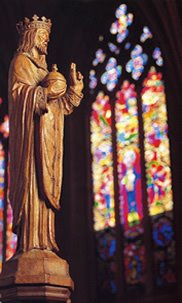
Really interesting conversation between (the always-fascinating) Jonathan Pageau and Dr. Martin Shaw about the lore and legends and symbolism around the Grail Quest.
I've been saying for about 25 years now, that we cannot actually sustain notions like "human rights" or "universal human dignity" without God, without the sacred. And I don't mean any old 'god' or 'religion' either, but specifically the God of Abraham, Isaac, and Jacob, the God who came among us in the person of Jesus. The God of the Bible, in other words, is the reason that it was Western Civilization - aka "Christendom" - that developed and spread (through colonialism and imperialism) the idea of human value and human equality.
There are good reasons that this notion did not develop in Mayan or ancient Chinese or even Islamic Civilizations. It is a Christian (or, if you like, "Judeo-Christian") idea. It is a teaching of the Bible, beginning from the first page.
Now, as I've said in other videos, I think more and more non-religious or 'less-religious' or 'spiritual-but-not-religious' Westerners are waking up to the truth that without Christ and the Bible, without Christianity, many of the things that they love best about Western Civilization, begin to fade away.
Will they do the obvious thing and start devoting themselves to the spread of Christianity? Will they go to church, give to missions, bring their children and grand-children (even if they aren't sure what to make of the theology and beliefs)? That's not everything they need to do, but it would be a good beginning. At the end of the day, however, Christ did not come to build Western Civilization. He came to save our souls from eternal death as we turn to him with repentance and living faith. May our world wake up to that truth as well.
Of course, the term "Dark Ages" is used differently by different people - some use it (especially in pop-culture) to refer to all of the Medieval Era, while others use it more precisely to describe Western Europe between the Fall of the (Western) Roman Empire and the Rise of Charlemagne and the Holy Roman Empire (the period roughly from A.D. 476-800).
It may well be that one day people will think of our own time as a "Dark Age" as well, as so many things seem to have declined since the late 20th Century.
IN any case, Oliver Murray, a high-church Anglican has another thought-provoking video on this that is worth chewing on (maybe even arguing with at points).
A couple of the most influential Anglican Christians on YouTube are scholars N.T. Wright and Michael Byrd. They've done some academic projects together, but also this pop-level YouTube channel. With any theologian - even one as significant as Wright - talking about complex issues completely "off the cuff" in response to questions can be a bit dangerous, but this is a good discussion from Wright and Byrd on Calvinism and the common (mostly Baptist) idea of "once saved always saved." Both men are (or so I thought) coming out of the more "Reformed" side of Anglicanism, which made this all the more interesting.
A highlight in this video is Wright being asked about his favorite books and movies. I'm pretty sure this guy does not have a big TV in his living room like I do.
Here is a really fascinating discussion about the Christian connections to various Halloween traditions. Of interest to me especially was the discussion towards the end of the parallels and oppositions between the traditional images, symbols, and meanings connected to witches and those connected with nuns. They don't say this in the video but it turns out that even the words "coven" (as in, a group of witches) and "convent" (where consecrated sisters or nuns live) share the same etymology.
Gavin Ortlund is, without a doubt, my favorite Reformed Baptist clergyman YouTuber. I really appreciate his charitable approach, intellectual rigor, and defenses both of Christian belief in general, and classical Protestantism as well.
I'm looking forward to the day when he sees the light on bishops and infant baptism.
Here is a video that Ortlund did celebrating the early Methodist revival movement within the Anglican Church led by John and Charles Wesley. It's a good video, especially in looking at the conditions in England before this 'awakening' and some of the lessons we might apply today.
Since today is "Aldersgate day" - May 24th, when John Wesley had his "heart-warming" experience of assurance from the Holy Spirit that really sparked the revival - I commend it to you. Today is a good day to remember just how much influence a Spirit-filled renewal can have on the whole of a society - and today is a good day to pray for another one.
I believe one of the problems that plagues Christianity, and has become a serious stumbling block to many non-believers (and indeed believers), has been the assumption that empirical/scientific knowledge is the only (or the best) form of knowledge.
I believe that what happened was, in early Modernity, with the rise of modern science there was such obvious benefit to the scientific method as a way of gaining knowledge that people - in their excitement over the advancements being made - began to assume that empirical knowledge (the kind of knowledge achieved through scientific observation and experimentation) was the best kind of knowledge. Some (such as the "Positivists") held that it was the only kind of knowledge.
Like Joe Friday in the old "Dragnet" TV show, people wanted to build a worldview on "just the facts."
Christians should have been challenging this Modern conception of knowledge, but I think that too often they accepted it uncritically. Part of the root of the whole "Fundamentalist/Modernist debate" of the late 19th and early 20th Century was (as I see it) both the Fundamentalists and the Modernists just assuming that 'facts' (in the scientific sense) were the supreme (or only) reliable form of knowledge. Then the Fundamentalist reasoned, "And since we already know that the Bible is a reliable guide to truth, and since facts are the supreme form of truth, it must follow that the Bible gives us the same sort of knowledge that science also gives us."
But in reality there are other sorts of knowledge than simply empirically verifiable facts that could be demonstrated scientifically. Supreme among them are "relational" forms of knowledge - what Anglican bishop and former Oxford professor N.T. Wright has termed "the epistemology of love."
The knowledge that my wife loves me, or that I love my children, may not be empirically verifiable in the same way that the distance to the Andromeda Galaxy can be demonstrated by scientific observation... yet these truths about my family are FAR more important to my life and decision-making than those facts about astronomy.
While it contains many historical facts (which in my view should not be presumed "false until proven true"), the Bible is - by its own description - a book about relationship. Look at how the purpose of Scripture is described by St. Paul in 2 Timothy 3:15 - "wisdom for salvation by trust in Christ."
The Bible is not a science text book, nor even a history text book (though it contains much true history within its pages) - it is rather more like a love letter: it is a writing that invites us into relationship. If we could keep that in view, many other supposed "problems" would turn out not to be so problematic after all.
I've been thinking about this lately because of personal conversations; Jonathan Pageau also has some thoughts along somewhat similar lines in this video:
For my money the conversations between Richard Rohlin and Jonathan Pageau on YouTube discussing "universal history" are perhaps THE most fascinating content on all of the internet.
Pageau is an Eastern Orthodox (former Baptist/Evangelical) artist and popular YouTuber. Rohlin is a former Baptist minister (I'm sensing a pattern here) who is now (if I'm not mistaken) a deacon in the Orthodox church.
Here is Rohlin (without Jonathan) discussing Tolkien's "Legendarium." This video - like all of the Universal History series - is WELL worth your time.
Great discussion and insight-filled discussion of the Temptation of Christ in the wilderness with Jordan Peterson, Jonathan Pageau, Bishop Barron, and others.
Another great talk from the ARC Conference (Alliance for Responsible Citizenship). This one detailing the negative impacts of screen-time for children and youth, and the complete lack of empirical basis for introducing screens for "educational purposes" into schools.
Despite the lobbying and marketing from software companies, he only evidence we have suggests a negative correlation between increased use of tablets and smartphones for "educational" purposes and actual educational outcomes - with all the other negative effects of screens on developing brains thrown in as well.
Here is a great talk from the ARC (Alliance for Responsible Citizenship) Conference from Roman Catholic bishop Robert Barron. He contents (rightly, in my view) that a renewal of Western Civilization requires God, it requires the lifting up of our gaze - our desires and ambitions - beyond the self, to the Infinite Source of Goodness, Wisdom, Truth, and Beauty.
"Don't buy into the modern lie that belief in God constrains the human spirit; the exact opposite is true!"
Something I've been talking about in recent months (as in THIS SERMON) is the importance of beauty in our own spiritual lives, and also beauty as a potent help to Christians wanting to stand out as winsome and attractive in a modernist world that has created so much ugly art, so many ugly buildings, and lost sight of the objective nature of Beauty as a glimpse of God's own nature.
One strong voice for what we might call a 'spirituality of beauty' or even using beauty as an evangelistic tool is the Roman Catholic Bishop, Robert Barron. He ponders some of these topics while reflecting on the unspoiled traditional beauty of the city of Prague in Central Europe.
This is a continuation of the theme of the recent post: another conversation with Rod Dreher on "re-enchantment" and his new book Living in Wonder.
This time Dreher is speaking with Jonathan Pageau, one of the most interesting "YouTube Intellectuals" for my money. Both men are Eastern Orthodox Christians, and in this video discuss the "darker side" of "re-enchantment" - the potential realities behind UFOs, a kind of AI spiritualism, and more.
In the conversation Dreher makes an offhand comparison to CS Lewis' masterpiece That Hideous Strength. In Lewis' novel he is (slight spoiler alert!) trying to describe narratively what he describes also in The Screwtape Letters: what the Devil would love to be able to cultivate is a person who is a "materialist magician." Because he is a materialist, he rejects traditional spiritual categories (and therefore rejects God and the Gospel), but nevertheless embraces a kind of neo-paganism but with a "scientific" or "modernist" framing or lens. Such a materialist-magician cannot believe in angels or demons, but he does believe in UFOs or telepathy.
IN That Hideous Strength the pseudo-scientific villains are in contact with, even doing the bidding of, demons. But they think of them as "higher life forms" or "extra-terrestrial intelligence." They call them "macrobes" rather than "spirits." But evil spirits they are.
We are living through what many scholars have described as a paradigm shift from Modernity into Postmodernity. Modernity was characterized by the linear, the literate, the rational, the scientific, the skeptical. Post-modernity is skeptical of Modernity itself, and is characterized by the eclectic, the emotional, the image (or the icon), the intuitive.
Modernity brought us modern medicine and vast corporate bureaucracies; postmodernity has brought us the organic homesteading movement.
Pageau and Dreher suggest - and I think there is definitely something to this - that UFOs are actually phenomena that have been experienced for many centuries, but whereas pre-Modern people would have interpreted them as "spirits", Modernity has given us a different set of lenses to "re-interpret" them as (essentially) astronauts from another planet. That is something we can understand and wrap our minds around rationally. But what if they are of a different order entirely?
The United Methodist theologian and advocate of "Paleo-orthodoxy" Thomas C. Oden argued that the crumbling of many aspects of Modernity as a world-view has opened a space for the church to rediscover the pre-modern teachers of the faith and a greater openness to the miraculous, the heavenly, the spiritual realities. This same dynamic may have also created a greater pastoral need for the church's deliverance ministries, as more post-modern people "mess around with" spiritual powers they do not understand. That's what Pageau and Dreher discuss in this really thought (and prayer) provoking video.
Let the villains in That Hideous Strength be a cautionary tale for us all.
The always informative Rev. Dr. Jordan Cooper shares about a 19th Century Lutheran thinker who may show us a way forward that preserves much of what is best in Classical Liberal political thought, but grounded in a coherent and Christian worldview.
Many churches traditionally read the Annunciation of the Angel Gabriel to Mary, the Mother of our Lord, on the 4th Sunday of Advent.
Quotes from the Annunciation in Luke's Gospel and also from John chapter 1 ("the Word became Flesh") are interspersed with the Ave Maria ("Hail Mary") in a traditional Roman Catholic devotion called the Angelus. In addition to the "Hail Mary"s, these are the Biblical verses and the prayer that are recited in this Devotion in remembrance of Christ's Incarnation:
The angel declared unto Mary, (Lk. 1:28) And she conceived of the Holy Spirit.
"Behold, I am the handmaid of the Lord Let it be to me according to your word." (Lk. 1:38)
The Word was made flesh And dwelt among us. (John 1:14)
The Angelus ends with a prayer that is also found in the Anglican Common Prayer book (at the end of the Mid-day Prayer liturgy):
Pour your grace into our hearts, O Lord, that we who have known the incarnation of your Son Jesus Christ, announced by an angel to the Virgin Mary, may by his Cross and passion be brought to the glory of his resurrection; who lives and reigns with you, in the unity of the Holy Spirit, one God, now and forever. Amen. (2019 Book of Common Prayer, p. 38)
Franz Biebl's musical setting of the Angelus is one of the most beautiful works of art that I know, and the amazing choral ensemble, Voces8, has (along with "The Ringmasters") put out a new recording of it just this month, which has already enriched my life.
I live in a parsonage, though in the past I've owned a condo. In the future I hope to own a house again. Many people of my generation will not be able to own a home, or not until late in life. Here is a discussion from the good folks at "Breaking Points" about new data indicating that, right now, the average age of a homebuyer is 56 years old. The average age of a first time homebuyer is nearly 40!
Our country faces a housing cost problem. It isn't as bad (yet) as in countries like the UK and Canada (which many young adults are fleeing), but it needs to be addressed by policy makers and financial institutions.
I suspect the increasing improbability of ever achieving "the American dream" is one more contributing factor in "the meaning crisis" or cultural malaise that so many commentators have been concerned about.
The Tabernacle, the Exodus, the Cross, and the Lord's Prayer
Here is a great video from Joe at the 'Young Anglican' channel in which he does a great job showing the symbolic and typological connections between the Story of Israel, the Architecture of the Tabernacle/Temple, salvation through Christ, and even the Lord's Prayer. Very interesting stuff, some of which I had not even noticed before.
The great New Testament Scholar and Anglican Bishop N.T. Wright uses a vivid image in one of his books about how the rationalism of post-Enlightenment Modernity has affected spirituality. With its insistence on elevating empirical and scientific knowledge to the highest (or even the only) reliable form of knowledge, dispensing with folk wisdom, intuitive, or spiritual forms of knowledge, Modernity was (spiritually speaking) like paving over a green field with concrete. But, over time, the concrete starts to crack. A hodge-podge of wildflowers and grass and weeds start to pop through.
Wright points to various movements - Romanticism, Spiritualism (with its seances), and New Age spiritualities - as reactions to the smothering rationalism. The spiritual realities - because they really are part of our life and experience - have a way of popping through the concrete. The Charismatic movement in the churches, the rediscovery of the Mystics through the Spiritual Formation movement, and the resurgence of Traditionalist forms of piety (as with the appeal of the Latin Mass among many younger Roman Catholics) are all Christian expressions of this same "popping through" of the super-natural. What the Rationalists dismissed as 'irrational' may actually be 'trans-rational' and have an unexpected staying power.
So, in recent decades, as scholars have noted the "paradigm shift" from Modernity into Post-modernity there has been an openness to re-evaluating and even reclaiming the spiritual and purpose-filled dimension to life that goes beyond empirical knowledge. Nowadays many people are talking - openly and excitedly - about the "Re-enchantment" or "Re-sacralization" of our lives in this world.
Here is one such conversation between news commentator Emily Jashinsky (of the 'Undercurrents' and 'Breaking Points' web-shows) and Eastern Orthodox Christian author and cultural critic (and personal friend) Rod Dreher about "Re-enchantment." It is very much worth the watch.
Tomorrow is the feast of "Corpus Christi" (The Body of Christ), commemorating the institution of the Lord's Supper. Here are two videos: First is Pastor and Theologian Gavin Ortlund describing how the classical Protestant view of Spiritual Real Presence compares and contrasts with the Roman Catholic view, Transubstantiation. While some centuries-old theological debates are so complicated that I hesitate to "come down hard" on any side, I do think the Reformers were being consistent with Scripture and ancient Tradition by rejecting Transubstantiation while still affirming the Real Presence of Christ's Body and Blood in Communion, as I discuss in the second video.