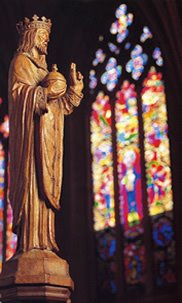
Many churches traditionally read the Annunciation of the Angel Gabriel to Mary, the Mother of our Lord, on the 4th Sunday of Advent.
Quotes from the Annunciation in Luke's Gospel and also from John chapter 1 ("the Word became Flesh") are interspersed with the Ave Maria ("Hail Mary") in a traditional Roman Catholic devotion called the Angelus. In addition to the "Hail Mary"s, these are the Biblical verses and the prayer that are recited in this Devotion in remembrance of Christ's Incarnation:
The angel declared unto Mary, (Lk. 1:28) And she conceived of the Holy Spirit.
"Behold, I am the handmaid of the Lord Let it be to me according to your word." (Lk. 1:38)
The Word was made flesh And dwelt among us. (John 1:14)
The Angelus ends with a prayer that is also found in the Anglican Common Prayer book (at the end of the Mid-day Prayer liturgy):
Pour your grace into our hearts, O Lord, that we who have known the incarnation of your Son Jesus Christ, announced by an angel to the Virgin Mary, may by his Cross and passion be brought to the glory of his resurrection; who lives and reigns with you, in the unity of the Holy Spirit, one God, now and forever. Amen. (2019 Book of Common Prayer, p. 38)
Franz Biebl's musical setting of the Angelus is one of the most beautiful works of art that I know, and the amazing choral ensemble, Voces8, has (along with "The Ringmasters") put out a new recording of it just this month, which has already enriched my life.
Like so many others, I too have found solace in watching worship services and listening to sermons online. One of the churches I have watched the most is St. Andrews Anglican Cathedral in Sydney, Australia, which is known as a Bible-believing and evangelical congregation based in a beautiful gothic cathedral, built in the grand Medieval style.
This is the opening hymn from their Christmas Eve service, and I have to say, it actually moved me to tears. During the last verse (which I've not heard before, though we sing this hymn every year), there is a shot of a tiny little boy - he looks about 4 - who seems to be so focused and working his absolute hardest to do his little part help bring this musical message of the Gospel out to the world.
That is even more beautiful than the cathedral. May we all, young or old, follow suite in our own callings.
I spent years as a child attending mass at my Roman Catholic School. Each week we entered a church, fragrant with with candles and hints of incense. Before us were statues of Jesus, Mary, and Joseph, and a statue of Christ crucified, as well as a priest wearing colorful robes. Surrounding us were dazzling stained glass windows depicting numerous Biblical stories and saints and Christian symbols, much of which I did not understand...but it clearly meant something.
Later in my youth I joined a fervently evangelical Baptist Church. Many evangelical churches - especially those with roots in the Puritan and Anabaptist traditions - have mostly eschewed iconography and art...though it does have a way of sneaking in from time to time anyway.
Indeed, when the church I attended remodeled its sanctuary (about the time I moved away for college), I was pleased to see that they replaced their opaque purple windows with far more colorful and attractive stained glass windows, each with identical images of the Cross.
These two churches point toward the different approaches Christians have taken to sacred art. Some Christians (those in the Puritan traditions) have looked with suspicion on all sacred art as potential idols that break the Second Commandment, which says: "You shall not make for yourself a carved image [or 'idol']...you shall not bow down to them..." (Exodus 20:4-5).
Other Christians have pointed out that later in the Book of Exodus itself God instructs his people to build a beautiful tabernacle of Gold and fine cloth and carpentry in which to worship Him, complete with images of plants and angels and golden statues of angels as well. These Christians (including Catholics, Eastern Orthodox, Anglicans, Lutherans, Methodists, and others) have to varying degrees embraced sacred art as an important reminder of the creativity and beauty of God.
I too have come to believe that works of artistic Beauty actually have profound theological significance. You may note that this is a theme running through my recent posts since the Notre Dame fire.
Not only do I believe works of Beauty have profound theological significance, but also that they will be an important pointer to the reality of God for some who may not be swayed by Reason or logical arguments for God's existence.
I've heard that Dostoyevsky, a Christian author who wrote the profound and theologically significant novel Brothers Karamazov (among others), once said "Beauty will save the world." I think there is truth in that.
In the beginning, the Bible tells us, God created the Heavens and the earth and all that is in them. "And God saw everything that he had made, and behold, it was very good" (Genesis 1:31). The word for "good" in the Greek version of the Old Testament that was used by many of the early Churches is 'kalos' which means "good, excellent, and beautiful."
But no one who has ever gazed upon the stars, or stood on the rim of a great canyon, or watched the setting sun needs a Greek or Hebrew word study to tell them that God's creation is beautiful and that He is a wondrous creator. And note: Man was formed in God's image, which accounts for our tendency to create beautiful things as well. J.R.R. Tolkien, a devout Christian whose magnificent work The Lord of the Rings contains a great many Christian themes, quite consciously saw his work in creating a fictional world as a reflection, however small and imperfect, of the world-creating work of the Living God whose image Tolkien was created to bear.
We have a good and beautiful God who creates a good and beautiful world (though it later became distorted by sin), and he populated it with people created to bear his own image who are themselves blessed with great creativity and love to make wondrous art to the glory of God. This is why Christians across the ages have written amazing works of literature, composed lovely music, crafted intricate statues and gorgeous stained-glass windows, painted icons, built inspiring sanctuaries and cathedrals.
Even among Churches of the more Puritan traditions you will almost invariably find quite handsome pulpits and very nice leather-bound Bibles with gold-gilt page edges, and will hear lovely hymns being sung, which are all types of sacred art. We humans cannot get away from this because we are embodied creatures who are creative by nature.
Fr. Patrick Smith, an Anglican priest who was a mentor to me in college (in explaining why his own Episcopal Church put such emphasis on beauty and artistic excellence, and was willing to commit resources to them) pointed out that God certainly does not disapprove of the material world or physical beauty - in fact he created it; and in the Incarnation of Jesus Christ he brought the very Life of God into the world of material stuff, transforming it forever.
This is the theological basis for embracing sacred art.
But such an embrace of beauty also strengthens the mission of the Church as well, which brings me back to the quote from Dostoyevsky: 'Beauty will save the world.'
There are many compelling logical arguments to believe in God. Yet Beauty has a persuasive power that transcends logic and reason; Beauty has the power to resonate with us on a very deep level; beauty stirs our longing for Him who is the fount of all the beautiful things, the source of all songs and wonder. We glory in all this beautiful sacred art not simply for its own sake, but also because it serves as a pointer to Him whose life is forever a Dance of supremely Beautiful, Sacred, and Divine Love.
It is into that Triune Dance that we are called by the same Christ who is also the true Way for us to get there.
I had an experience a few years ago that powerfully brought this all together for me (again). I went with a group from the church I was pastoring to Saint Joseph's Abbey in Covington, Louisiana for a quiet retreat. Our group was invited by the monks to join with them in chanting the Psalms at their prayer offices sprinkled throughout the day.
On our last night of the retreat, a storm rolled in after we had attended Vespers (Evening Prayer) and eaten dinner. At first there was no rain, only a howling wind, and distant flashes of lightening and sounds of rumbling thunder. I decided to walk to the glorious Abbey Church rather early before Compline (Late-Night Prayer), in order to beat the rain. I found the church very dark - lit by a single candle in the sanctuary - with flashes outside occasionally lighting up the whole place. When the rain started it came down hard and loud. I sat down to pray and, after a few minutes in the quiet, turned on my MP3 player, and this is what I heard (close your eyes and imagine you are sitting in the vast, dark Abbey, with the storm raging outside):
Actually, the exact recording I heard was this one (which is even better, but has an annoying commercial before it).
I tell you, this experience was like another conversion. In that moment I felt that even had I been a militant atheist I would have been converted to faith in Christ by the sheer transcendent beauty of the experience.
Indeed the words of the repeating chorus are the traditional Ave Maria ("Hail Mary") - half of which is taken from Luke chapter 1. The other words of the more plain-chant sounding verses are also taken from the Birth narratives of Christ (such as Luke 1:38 and John 1:14). The song tells of the embodiment of the Good and Beautiful Creator God in the flesh, through the Virgin Mary, taking up residence in this material world. The song was not only about the incarnation of God in Christ in the world, but the beauty of the song, and of the Abbey where I sat, were indeed embodied, that is incarnate, witnesses to this same spiritual reality. It is hard to fully put into words how Beauty and Truth came rushing together upon my soul in those moments of meditating upon the beauty of the Incarnation of Jesus.
By comparison, the worldviews of atheism and secularism and the kind of "generic popular culture" that secularism produces is utterly incapable of producing anything like this kind of sublime experience of deep soul-stirring beauty. They can entertain, but they cannot inspire anyone with a genuine experience of transcendence; indeed, for these worldviews, there is no actual transcendent Reality beyond our own feelings. For this reason, they simply haven't the spiritual depth and mystical freight that is necessary to drive men to erect cathedrals or to inspire the writing of Mendelssohn's "Lift Thine Eyes," or to sustain our Civilization into the future.
The fact that such timeless works of art exist at all, points us to the truth that there is indeed a Transcendent reality - a Divine Logos - And that Word, that Logos, says the Christian faith, was became flesh, and dwelt among us, and his name is Jesus.
So let the people of Jesus - in word, deed, character, and work - be people of creative and life-giving beauty.
Last year my wife Christene and I were blessed with the chance to take a pilgrimage to the Holy Land. One of the final places we visited on that journey was the Church of the Visitation where (perhaps) the Virgin Mary came to visit her elderly but pregnant relative Elizabeth (it certainly is the location of the cool statue pictured here). In the Western Church, the Visitation is traditionally celebrated today, May 31.
The Visitation is recorded in Luke chapter 1 and gives us some of the Bible's loftiest language in celebration of the Virgin Mary and her unique place in salvation history: Elizabeth calls Mary by the title "Mother of my Lord" and greets her (by the Holy Spirit's prompting) with the words: "Blessed are you among women, and blessed is the fruit of your womb..." (v.42) I might also suggest that when John the Baptist "jumps" in the womb for joy at the presence of Mary and (presumably) of the fetal Jesus as well in this passage (v.41 & 44) we are also given a very profound insight into the sacred humanity of unborn children still in the womb.
While Mariology has often been a dividing point between Roman Catholic (and Orthodox) and Protestant Christians, these verses provide us with the core of a Mariology that is both catholic and reformed: catholic in that we seek to celebrate Mary as the church across the ages has always done (not ignore her as some Protestants have done), and reformed in that we want our celebration of Mary to be in keeping with the Biblical witness so as not to stray into the worship of Mary or exalting her out of proportion - which she herself would flatly reject and abhor.
It is on this occasion that Mary, the Mother of our Lord, speaks the words now known as The Magnificat: "My soul magnifies the Lord..." (see Luke 1:46-55); these words of St. Mary the Virgin have come to be recited and sung all across the ecumenical church as one example of a truly "catholic" and thoroughly Biblical way of honoring Mary. The Visitation is one of two "Marian feasts" (the other being the Anunciation) for which our United Methodist Book of Worship provides liturgical resources, including this prayer:
Almighty God, you inspired the Virgin Mary, mother of your Son, to visit Elizabeth and assist her in her need. Keep us open to the working of your Spirit, and with Mary may we praise you for ever. We ask this through Jesus Christ our Lord, who lives and reigns with you and the Holy Spirit, one God, now and for ever. Amen. (The United Methodist Book of Worship, 257)
In celebration of the Visitation today, there is a video below of the choir at Westminster Abbey singing an arrangement of the "Magnificat" at Evensong (Vespers/Evening Prayer) on the occasion of Pope Benedict's visit to England in 2012. The "Magnificat" is a standard element of the Anglican Evening Prayer service (see The Book of Common Prayer 1979, p. 119 and 113) and also of the United Methodist Order for Evening Praise and Prayer (see The United Methodist Book of Worship, p. 575) because the Methodist service - like most all of our liturgy - flows out of the Anglican liturgical tradition.
Since being moved by my bishop to a regular parish-church setting, I have had the great pleasure and privilige of planning for worship services each and every Sunday, and for this reason I've spent much more time working with The United Methodist Book of Worship (UMBOW), the official liturgy and worship book of our Church. This book, in addition to our full services for the Lord's Day, the Sacraments, and the major rites of the Church such as marriage and funeral, also contains numerous prayers, collects, and liturgies for use throughout the Christian year. Many of these prayers have roots in The Book of Common Prayer and other classical liturgical sources, while others are more recent.
In the Advent section, I discovered resources for two "Marian" feast days (focusing on Mary, the Mother of the Lord) traditionally celebrated by Anglicans, Lutherans, and Roman Catholics: The Annunciation to Mary, and the Visitation of Mary to Elizabeth. These feasts are not traditionally observed during Advent, but since that is when our lectionary and preaching is most likely to highlight the texts dealing with the Incarnation of the Word through Mary, that is where our worship book has them (UMBOW 256-257).
I have argued before that we Protestants, if we are serious about pursuing Christian unity with our Roman Catholic and Eastern Orthodox brothers and sisters, need to find ways to highlight and celebrate the unique witness and work of the Virgin Mary, while remaining true to our own convictions that the Triune God alone is the proper object of worship and prayer and that Jesus is our only mediator with God and our only Savior. The editors and compilers of our United Methodist Book of Worship have done exactly that - prepared liturgical resources that celebrate the Biblical witness to St. Mary's role in God's plan of salvation, without going beyond what the Bible teaches.
Today, March 25, is traditionally celebrated as the Annunciation by the Angel Gabriel to the Virgin Mary (Luke chapter 1:26-38) because it is exactly 9 months before Christmas Day on December 25.
To commemorate the Annunciation our Book of Worship offers the following (UMBOW 256):
Suggested Readings: Isaiah 7:10-14; Psalm 40:1-11; Hebrews 10:5-10; Luke 1:26-38
Suggested hymns from The United Methodist Hymnal: 199, 198, 200, 215, 197
Prayer:
Holy God, the mystery of your eternal Word took flesh among us in Jesus Christ. At the message of an angel, the Virgin Mary placed her life at the service of your will. Filled with the light of your Spirit, she became the temple of your Word. Strengthen us by the example of her humility, that we may always be ready to do your will, and welcome into our lives Jesus Christ our Lord. Amen.
As we move through Advent towards Christmas, there is more talk in Protestant and Evangelical circles of Mary, the mother of the Lord Jesus. Perhaps many of us are watching The Nativity Story. It seems Christmas time is when we Protestants feel least nervous about using 'the M-word.' In the wake of a greater ecumenical consciousness emerging among evangelicals there has been lots of recent discussion and a flurry of books by Evangelicals about Mary.
Of course, the popular perception is that differences in how we regard Mary is one of the prominent differences between Protestants and Catholics. I will not explore the question of "official" Roman Catholic teaching versus popular practice on this subject, though I personally find the official teachings much more agreeable than some of the more pagan-looking popular practices (about which I know very little). As C.S. Lewis said in the preface to Mere Christianity, Protestants see an over-emphasis onMary as striking at the root of Monotheism itself. Anytime we here language about "co-redeemer" our worst fears about the Roman Catholic excesses seem to be confirmed - since clearly only the Lord can save, only the Lord is our mediator (as Vatican II also affirmed).
I've been thinking alot about Mary lately myself and how integral she will be to restoring the unity of the church (Pope John Paul II/'the Great' said as much in Ut Unum Sint). As I have been thinking about Mary several things have come to the fore for me. Mary is, in Scripture (especially in St. Luke's writings), the first and exemplar disciple, even the paradigmatic disciple. She, in perfect and humble faith and obedience, gave of her very physical essence to make possible the Incarnation of the Word of God - of her very flesh God became flesh! She is always near Jesus - present for the whole of his ministry, beginning from his conception to his birth; she carried him on his prophecy-soaked return from exile in Egypt as a child. She nursed him as a child and supported his ministry in many ways. Of course she must know him in more intimate ways than is possible for any other disciple or saint.
Mary was present at his first miracle where she told the servants concerning Jesus "whatever he says, do that." (John 2) She was faithful even to remain with him at the foot of the cross. She bore much pain and sorrow for Christ, her son, whom she bore and whom she buried. Mary is the link between the old and new covenants - a daughter of Israel, the mother of a prophet like Hannah before her, who also was present in the upper room with the disciples, awaiting the Pentecostal outpouring of the Spirit. The angel repeatedly calls her the "favored one" and the Spirit, through Elizabeth says she is "Mother of my Lord" and "blessed are you [Mary] among women and blessed is the fruit of your womb." Mary herself is a prophetess singing words that are now Scripture: "My soul magnifies the Lord and my spirit rejoices in God my savior...for the Almighty has done great things for me...from this day all generations shall call me blessed." By God's sovereign choice and Mary's faithful response, she is utterly unique among all the saints and has a uniquely pivotal place in salvation history. As Tim Perry puts it in his book Mary for Evangelicals “if Mary did not bear God in her womb – if she is not Theotokos ("God-bearer" or "Mother of God") – human beings are not saved” (p. 271).
And since Christ is the Messianic King of Israel - the "son of David," she must surely in some sense be "the Queen mother," who is a very important figure in Hebrew notions of Kingship (or so I am told by Catholic and Evangelical scholars). So in light of all this, let us let go of our Protestant excesses and fulfill her prophetic word by calling her blessed.
Here is an article at "First Things" by Timothy George, a Southern Baptist and one of my favorite Evangelical scholars (because he is ecumenical in scope), along these lines arguing that Evangelicals can recover their own Mariology. He says Evangelicals (without ceasing to be Evangelical) can and should emphasize 5 aspects of Mary's calling. She is 1) THE daughter of Israel, 2) the virgin Mother of Jesus, 3) the Theotokos, 4) the Handmaiden of the Word and 5) the Mother of the Church. He explores these themes in Scripture, the Early Fathers, and the Reformers (who generally had their own sort of Marian devotion that Protestants have since lost) arguing that they are perfectly congruent with Evangelical theology and he ends with a Marian prayer that he has composed.
A very appropriate Marian prayer that may be used on a regular basis by Protestants attempting to recover a Biblically-balanced Mariology is Collect for the feast of The Visitation (May 31) in The Book of Common Prayer, 1979 (p. 240):
Father in heaven, by your grace Mary the virgin mother of your incarnate Son was blessed in bearing him, but still more blessed in keeping your word: Grant us who honor the exaltation of her lowliness to follow the example of her devotion to your will; through Jesus Christ our Lord, who lives and reigns with you and the Holy Spirit, one God, for ever and ever. Amen.
In reflecting on Mary I have also composed (and begun to use) several Marian prayers, shorter and longer variations on the same basic idea.
Almighty God our Savior,
you are holy, glorious, and good:
We thank you for the witness of all your saints,
especially your [favored] servant, the Virgin Mary.
Blessed is she among women and blessed is the fruit of her womb, Jesus.
She believed your word of promise,
And by your great power she has become the Mother of my Lord [and Theotokos].
Look with mercy upon us, O Father,
And grant that we may follow in her courageous faith
As we humbly pray with her:
'Be it done to us according to your word,'
That our spirits may rejoice in you
And our lives magnify your glorious Name;
Through your Son and Mary's Son: Jesus Christ,
Who lives and reigns with you and the Holy Spirit
One God, now and forever. Amen.
Notes:
I am as yet undecided (though I will investigate this until I am decided) on the issue of how the saints may intercede for us and whether we should ask them too - that is, what kind of intercourse exists between the living and departed saints (and whether this must imply the omni-presence of the saints?). This prayer could be interpreted to mean that we pray for ourselves while with the expectation that Mary intercedes for us (which may satisfy Roman Catholics) - or simply that we pray using the same words that she once used (which should satisfy any Evangelical Protestant), or any position in between.
The wording generally comes from Luke 1:28-30, 38, 41-48 (and 48-55), as well as the theological formulation of the Fourth great Ecumenical Council at Chalcedon in 451. This prayer could be used daily or weekly (either of those would be my preference) and may be especially appropriate during: Advent and Christmas, The Feast of the Annunciation (March 25), The Feast of the Visitation (May 31), Mothers' Day (2nd Sunday of May), and The Feast of St. Mary the Virgin (Aug. 15) (all dates are Anglican usage).
On an interesting side note, I recently read that Luther himself (at least for a while) argued that there was an appropriate way for the Christian to use the "Ave Maria"/"Hail Mary" without necessarily being trapped in 'Roman corruption' and all that. Certainly his own Mariology is apparent in some of his sermons about her faith. This is, along with Luther's continuing the practice of Eucharistic Adoration (thought limiting it to a few moments within the mass itself) rather surprising to me, based upon my presuppostions as an American about what is "Protestant."