7/21/26

The SSPX and the "Traditionalist Catholic" Dilemma

 This issue gets at some of the reasons I am not personally Roman Catholic; but I pray for the day when, under the renewing and reforming guidance of the Holy Spirit, all of our churches will have visible unity again.


Labels: , , ,

5/25/26

Anglicanism's Ancient approach to Eucharist

 Here is a great video from Sean Luke at "Anglican Aesthetics" showing how the Anglican approach to Holy Communion is consistent with and finds support among some major Early Church Fathers and saints of the holy catholic church. 

This is one of the MANY examples of ancient fathers whom the Roman Church "officially" considers to be saints also holding views that, according to the Council of Trent, also "officially" cause them to be anathematized.  


Labels: , , , , , , ,

4/18/25

The Book of Common Prayer: Devotional Masterpiece

 A history of the Book of Common Prayer using my own collection of Prayerbooks for reference.

Labels: , , , , ,

5/29/24

Corpus Christi: Real Presence in Holy Communion

Tomorrow is the feast of "Corpus Christi" (The Body of Christ), commemorating the institution of the Lord's Supper.  Here are two videos:
First is Pastor and Theologian Gavin Ortlund describing how the classical Protestant view of Spiritual Real Presence compares and contrasts with the Roman Catholic view, Transubstantiation.  While some centuries-old theological debates are so complicated that I hesitate to "come down hard" on any side, I do think the Reformers were being consistent with Scripture and ancient Tradition by rejecting Transubstantiation while still affirming the Real Presence of Christ's Body and Blood in Communion, as I discuss in the second video. 


Labels: , , , ,

4/29/24

Why should a church have bishops?

 I believe in bishops.  I've had both really good and really bad experiences of Episcopal oversight, but experience is not what drives my belief system: the Bible interpreted through the historic church is.  That is why I believe in bishops.  

I know that this is an active topic of discussion among Methodists - and the Global Methodist Church in particular will decide later this year about whether to accept bishops at all and, if so, what sort of bishop it will be.

In this video I explain some of the reasons (there are others) why I think bishops are essential for the flourishing and especially for the unity of the whole church, and the congregations within it. 


Labels: , , , , , , , , ,

1/21/24

Can Evangelicals Accept Purgatory?

 Of course, it comes down to what we mean by "Purgatory".  But I do recommend this discussion; rather than simply repeating slogans of the past, they really do explore important questions about our relationship with God and how Bible-believing Christians might approach them.  I certainly do not accept the Medieval idea of Purgatory as Christian believers "doing time" and being punished for sins after death before we can enter into Heaven, but there is a sense in which we believe we will be further "purged" at the end of this life so that our hearts will be able to receive the Glory our Father has for us. 


Labels: , , , , ,

12/4/23

Great Video on Eucharistic Theology

 Mr. Jonah Saller's "Mere Catholicity" YouTube channel is worth checking out.  He is a very thoughtful Anglican layman who is well-read.  In this video he lays out an approach to the Real Presence of Christ in the Lord's Supper that both takes on board the Lutheran (and Roman Catholic & Eastern Orthodox) concern that the Spirit actually does do something objectively to the elements themselves, to "make them be for us the body and blood of Christ".  Yet he also wants to take on board the concern of the Protestant Reformers that we can only receive Christ's presence in the Supper if we have faith.  "Make them be for us the body and blood of Christ." 

I broadly agree that an understanding that is both Biblical and informed by universal tradition should include both of these concerns.  


Labels: , , , ,

10/16/23

Branch theory: A Cursory Defense

 One YouTuber I've recently run across and really profited from/enjoyed is Jonah Saller at the Mere Catholicity channel.  I believe that Mr. Saller is an Anglican layman and has lots of really thoughtful videos advocating for a "reformed catholicity".  Here he discusses the view held by many (but not all) Anglicans called "Branch theory" - the idea that the original undivided and catholic church founded by Christ has divided into (at least) three branches that can all claim to be legitimately "catholic" continuations of that original "trunk" with the same validity of ordinations and sacraments: the Eastern Orthodox, the Roman Catholic, and the Anglican branches.  While some Anglicans use "Branch Theory" to "de-church" other Protestant churches, Mr. Saller - in this an other videos - takes a more generous (and, I would argue, a more realistic) approach: other Protestant churches are clearly real parts of Christ's church that really experience the saving grace of Jesus Christ; but there are gifts of catholicity (such as Apostolic bishops) that God intends for them to have, which they currently lack. 


Labels: , , , , , , , , ,

2/19/22

The Reformers wanted a stronger Eucharistic piety

1/25/22

How I came to a Sacramental view of Baptism

 Embracing a Sacramental view of Communion was pretty straight-forward once I started reading more of the Bible, but it took a bit longer to come around on Baptism. 

Labels: , , , ,

7/14/21

Grace, "Means of Grace," and Sacrament in Wesleyanism

4/14/21

The Daily Office & John Wesley's Common Prayer Book Revision

 This video is an introduction to the spiritual discipline of "The Daily Office" or "The Divine Hours", with a focus on the Biblical foundations of the practice, the practice of the Church of England in Wesley's day, and how the Daily Office was revised and passed along to the Methodists by John Wesley.


Labels: , , , , , , , , ,

3/24/21

Review of "A Daybook of Prayer"

3/5/21

The Book of Common Prayer and John Wesley

12/23/20

The faith and spirituality of the Creeds

12/16/20

Why some Protestant churches look "Catholic"

10/14/20

Mere Christianity by C.S. Lewis

My reflections on one of the Great Ones:


Labels: , , , , ,

9/1/20

The CS Lewis Bible and The Ancient Modern Bible

Here are my thoughts about Devotional Bibles, and two in particular, the CS Lewis Bible (NRSV) and the Ancient-Modern Bible (NKJV)


Labels: , , , ,

5/28/19

Does Protestantism contribute to Western Civilization?

St Paul's (Anglican) Cathedral, London

I follow a few Roman Catholic bloggers, thinkers, and video bloggers.  As fellow Christians we have a great many shared interests morally, spiritually, politically, and culturally: we proclaim the same Risen Christ, read the same New Testament, recite the same Creeds, worship on the same Holy Days (and even sing some of the same hymns), advocate for the same moral values.  Despite the fact that we have some different understandings of the church, spiritual authority, and how our relationship to God 'works', we nevertheless share a great deal of common interest and concern.
In fact, I would say that Roman Catholics more than either Evangelical or Historic Protestants are really on the forefront of thinking through how to revitalize and preserve Western Civilization.

This is a good thing because (despite the naysayers in some quarters of our culture), while every civilization has its evils (including the West), nevertheless Western Civilization has done more to promote goodness, freedom, truth, reason and mercy than any other human movement in History, and I'm very proud to be a product and heir of it.

Western Civilization is inescapably bound up with Christianity, so much so that Winston Churchill quite happily called it "Christian Civilization".  Inspired by the Christian message, the artistic and spiritual achievements of Western Civilization are simply staggering.

But what I've noticed is that you'll sometimes hear Roman Catholic thinkers say something along the lines of "When I say Western or Christian civilization, I am essentially talking about Roman Catholic Civilization, because the two are the same thing..."  Indeed, a few would even point to the iconoclastic tendencies of some forms of Protestantism (i.e. Puritanism), to argue that Protestantism as a whole has been a corrosive influence on Western Civilization, rather than really a contributor to it.

But clearly it is a mistake to equate Western Civilization with the Roman Catholic Church or its members' contributions.  For one thing, a major contributor to Western Civilization is without doubt the pre-Christian Grecco-Roman heritage.  The art, architecture, literature, philosophy, and legal traditions of Athens and Rome are absolutely essential to Western Civilization, and yet none of these were originally created by Roman Catholics.  Yet what would Western Civilization be without Homer or Plato or Aristotle or Virgil or Cicero?

Even if we narrow the discussion to Christendom and explicitly Christian achievements, we still find that there are major contributions to Western Civilization coming from non-Roman Catholic sources.  For example, if Greece is part of Western Civilization (and it obviously is), then that means that the cultural achievements born out of Eastern Orthodox Churches need to be considered right along side those of the Roman Catholic Church.  And it is certain that the contributions to Christian Civilization coming from Eastern Orthodox creators such as Rachmaninoff or Dostoevsky are substantial.

There can be absolutely no doubt that Protestants also have also made major positive contributions to Western, Christian Civilization as a whole.  A few examples:

Music:
I once heard the (Roman Catholic) Philosopher Peter Kreeft say that one reason he believed in the existence of God was simply the music of Johann Sebastian Bach.  I agree.
And Bach was a Protestant; he composed major spiritual works such as the St. Matthew Passion.
Beethoven was Roman Catholic, to be sure...but Handel was Protestant.  Palestrina was Catholic, but Mendelssohn was Protestant.  So were Paul Manz, and Hubert Parry and John Rutter and Henry Purcell.

Sacred Architecture:
Catholics are quite right to celebrate the great medieval and Renaissance churches...but what of the very iconic and significant contributions to sacred architecture made by men such as Sir Christopher Wren or Richard Upjohn?  The Gothic revival itself was born in Protestant England.

Visual Arts:
I'll freely admit that most of the greatest visual artists, especially those working with Biblical and Spiritual themes were Roman Catholics, such as Michelangelo and Raphael.  But surely the contributions of a Protestant like Rembrandt are nothing to sneer at either?

Literature:
Catholics are quite right to rejoice in the majesty of Dante's Divine Comedy.  But what of Milton's Paradise Lost?  What of Bunyan?  For that matter, what of Shakespeare, whose work is shot through with spiritual themes?  All Protestant.

Many younger Roman Catholics that I know are glad to count Tolkien and Chesterton among their number.  And well they should be, for these are simply outstanding authors.  But let us not forget that C.S. Lewis, George MacDonald, Dorothy Sayers, T.S. Elliot, and Charles Williams were all Protestants.

Of course, for English-speakers the King James Version of the Bible is itself an extremely important contribution to our literary tradition.

Ideas and Learning:
In terms of the "big ideas" that shaped Western Civilization, the Protestant affirmation of 'the priesthood of all believers' meant that each believer was equal in the community of faith, which led to the birth of modern notions of equality and the belief that every citizen should have a say in government (i.e. 'one-man-one-vote' style democracy).  This is why the Pilgrims on the Mayflower all got together and voted on a written constitution for how their colony would be run, which has had a tremendous impact on the emergence of our American Republic.  The Protestant insistence that everyone should read the Bible for himself led to the development of universal education and widespread literacy.

Institutions of higher learning such as Harvard, Princeton, and Yale and many others besides, which have come to have tremendous cultural influence, were originally created for the stated purpose of spreading Protestant Christianity.  This is barely even to begin to scratch the surface of the influence of Protestantism on Western thought and ideas over the course of these last 500 years.

Certainly, I do not aim to downplay the absolutely essential and glorious contributions of Roman Catholics to our Civilization; they are profound.  Nor am I suggesting that we should be content to enjoy or celebrate the contributions of only our own particular branch of Christianity.  The truth I want to highlight is that members of all three major branches of Christianity - Eastern Orthodox, Roman Catholic, and Protestant - have made significant contributions to our Christian Civilization, and we should celebrate and share together all of them as gifts to us all from the Lord whom we all profess.

For the reasons noted in my previous post, I have come to believe that it is Secularism (not Protestantism) which is incapable of making significant contributions to our civilization, because it has no great Beauty with a capitol 'B' or Truth with a capitol 'T' that has the power to captivate men's minds and inspire their creativity for centuries on end, as the Lord of the Bible has indeed done for Western Civilization.

Labels: , , , ,

8/3/17

The "Senses of Scripture"

One of the many things I did not learn much about in seminary was how virtually all Christian clergy were taught to interpret the Bible before about the year 1800.

My seminary education focused upon the approach to Scriptural interpretation called the Historical-Critical method, which attempts to reconstruct the original historical context, the purpose in writing, the original author and audience, and so on to give insight into the meaning of specific books of the Bible.

Historical-Critical method is, in fact, very valuable to understand the original meanings of a Scripture passage, and I still read good Historical-Critical Bible scholarship to this day.

However, this method does have significant shortcomings.  It is (sometimes) great for gaining insight into a single letter, or single book, or single piece of writing, but it does not usually give much attention to the place of these writings within the canon as a whole; and while it is good at treating Gospels as Gospels and Letters as Letters and Poetry as Poetry, it does not always give much attention to treating any of them as Scripture.  The focus is generally on the original purpose of these writings, without attention to their subsequent, canonical use within the life of the church.  The preacher is (hopefully) attuned to scholarship, but also more than a scholar, using the Bible for pastoral purposes.

Another short-coming of Historical-Critical method is that, like so many fields in the humanities, it purports to be a "scientific" endeavor in some respects, but where 2 or 3 Historical-Critical scholars are gathered, you can be sure there are multiple contradictory approaches and conclusions on nearly everything in the field of Scripture study.  There is a great deal of confusion within the field itself at the moment, which lends a degree of uncertainty to almost every assertion about what "modern scholarship has revealed."


I did, however, eventually discover that before the rise of this, distinctively Modern, approach there was another, richer, approach to interpreting Scripture.  Early Church Fathers and Medieval theologians happily spoke of the various different "senses" of Scripture: a single passage could, and did, have more than one meaning.  The most typical approach (but not the only one) spoke of 4 different "senses" of Scripture.

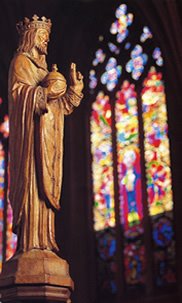
Consider these words of Saint Augustine (pictured):
"In all Sacred Books we should consider eternal truths that are taught, the facts that are narrated, the future events that are predicted, and the precepts or counsels that are given." (from De Genesi Ad Litteram 1:1)

The different 'senses' of Scripture have been neglected in Protestant seminaries in part because of the Reformers' reactions to the abuse of non-literal interpretations and in part because of the desire by modern Biblical scholars to present themselves as "scientific" (read: "legitimate") within the modern academic guild.
In fact - despite not being formally taught in Protestant seminaries - these approaches to Bible interpretation have persisted in our churches because they are, for the serious Bible-reader, almost intuitive.  They have now been smuggled back into the seminaries through the Spiritual Formation movement and the rediscovery among Protestants of Lectio Divina.  These other, non-literal, approaches also allow passages of Scripture that would otherwise be obscure or irrelevant to continue to "speak to us" today.

To get a sense of how the different "senses" work, consider the story of David and Goliath in 1 Samuel.

Historical-Critical exegetes (interpreters) look at the story in historical terms of "the facts that are narrated": an Israelite boy entered into single combat with a Philistine warrior to defend the honor of YHWH.  The Historical-Critical exegete then asks historical questions: what do we know about single-combat in the warfare of the Ancient Near East?  Who were the Philistines and what historical evidence do we have about them or their culture?  What does this story say about the development of kingship in Israel's history?  Is the story we have the original form?  How does the author/editor(s) of this story want us to view David's dynasty, and why (that is, what is the "agenda" behind the text)?
And the always-popular among (modern) Historical-critical exegetes, "did this event actually happen as an historical event?"

In Early Church and Medieval terms, this approach comes closest to what is meant by the "literal" sense of Scripture: as Augustine says above, "the facts as they are narrated."

The literal sense is important, and is the first and most obvious starting point in understanding any passage of Scripture.  But there are other ways to read the story of David and Goliath, other "senses" of the Scripture.  There are, what might loosely be termed, "spiritual readings" of the text.

One is the allegorical sense.  Goliath represents temptation or opposition which we all, in our different ways, face.  David represents faith and reliance upon the God of Israel to bring us victory.  The story is now about "facing the giants" in our own lives.  There are eternal truths here.

Another, closely related, sense is the Typological reading.  Some classify this as a form of allegory, while others treat it separately.  Typology is frequently used and mentioned in the New Testament.  "Type" here is related to our concepts of "prototype" or "archetype."
David is a "type" or a "sign-post" pointing to Christ, who is the "antitype."  David defeats the pagan Goliath and becomes enthroned as king over Israel.  Jesus defeats Satan and Sin in "single combat" and becomes enthroned over Israel and, therefore, over all the world.  As with the allegorical reading above, this is not what the David and Goliath story is "literally and historically" about in the mind of the original audience, but it is one way that this story has been read as the Living and Active Word of God since the days of the Earliest Church (see, for example, 1 Peter 3:20-21 where the flood story of Noah is said to represent Holy Baptism).

Another approach to reading Scripture is the "moral" sense (called the "tropological" sense).  Look at the great virtues exhibited by David who is faithful, courageous, and humble.  Look at the vices of Saul and Goliath and the other characters, and learn from their examples, there is counsel here for how to live a good life, if we pay attention.

Yet another "sense" of Scripture approaches it in eschatological terms: What does this say about the final destiny of the world and humanity?  This approach is classically called the "anagogic sense."  In this reading, David's defeat of Goliath can symbolize and predict the final victory of God's Kingdom over the forces of idolatry that currently enslave so much of his good creation.

These various other "senses" of Scripture, alongside the historical/literal sense, are quite frequently of great importance for the work of a preacher or Bible-teacher as a spiritual shepherd within the living community of the Church, and deserve more attention than they currently get in our seminary training.

HERE is a nice article from a Roman Catholic theologian named Pauline Viviano examining the different "senses" (including the Historical-Critical sense) that have been applied to Bible-interpretation.  It serves as a great introduction to this topic.

Labels: , , , , , ,