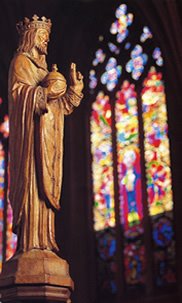
Here is an interesting video on the de-enchantment or de-sacralization that has taken place in Western Civilization and how to re-enchant or re-sacralize our collective imagination in order to save the soul of our Civilization.
Though an Anglican, he is perhaps a little too hard on the Reformation (it is worth noting that the collapse of religious observance has been quite profound in culturally Roman Catholic and Eastern Orthodox countries as well as Protestant ones), but I cannot deny that some of the factors he mentions (such as the dissolution, rather than the reform, of the British monasteries) probably did not help much.
I do not see anything fundamentally contradictory between monasticism as a vocation and Protestantism's recovery of the great truths of grace and Biblical authority and "heart-religion," and I'm glad to see that today there are some Anglican, Lutheran, and ecumenical monasteries and convents and similar monastic communities devoted to prayer, study, and simple acts of service.
In any case, I share this video because I think he is quite right in describing some of the spiritual problems facing the West today, and some of the potential medicines, including the importance of recovering older and more nuanced approaches to Scripture, and to the importance of symbolic forms of communication, than what is often on offer among Protestants (conservative or revisionist) these days.
The Daily Office & John Wesley's Common Prayer Book Revision
This video is an introduction to the spiritual discipline of "The Daily Office" or "The Divine Hours", with a focus on the Biblical foundations of the practice, the practice of the Church of England in Wesley's day, and how the Daily Office was revised and passed along to the Methodists by John Wesley.
Rod Dreher on Defending and renewing Western and Christian Civilization
This is an interesting video that brings together a number of authors and themes that I've been chewing on in recent years: He talks about Patrick Deneen's thesis in Why Liberalism Failed, about how Christianity has been supplanted in the hearts of many by "spin-off religions" such as "Moralistic Therapeutic Deism" or "Social Justice Warrior-ism." He discusses Alister MacIntyre's After Virtue, and how the Benedictine monasteries preserved Western Civilization as the Roman Empire collapsed and knowledge and technology actually regressed. He discusses practical things that we can be doing to help preserve the legacy of all that is best in Western Civilization (while also being frankly honest about the bad and the ugly).
Definitely alot to chew on here (and maybe a bit some readers may want to spit back out); I certainly think Dreher is on the right track here, and have come to see my role as a parent and as a spiritual father to my church as passing on, first and foremost, the Biblical faith in Christ, and secondly as passing along the very best of the Western tradition to others.
I just wanted to briefly post to share a link to a blog from a like-minded Methodist thinker working to recover and promote Methodism's rich liturgical and sacramental heritage: High Church Wesleyan: Rumination by Dr. Ryan N. Danker.
Also, though his blog, I've discovered The Charles Wesley Society, which just had its annual meeting in Washington DC (missed it!). I think religious orders and religious societies are wonderful tools that God has used to strengthen and defend and renew the Church and her faith over the centuries, so I'm always excited to discover more of them.
Not sure how much blogging I'll do in the future, though I do have at least a couple more posts-in-formation. Having a busy pastorate, a family, a ridiculously long reading list, and even a few other hobbies has certain forced me to cut back on blogging, but life is full with blessings and I'm content. Thanks be to God.
A few years ago, some of my friends told me that I was a "Crunchy-Con." I had no idea what they meant and they explained that I was one of those socially conservative, nature-loving, environmentally friendly, peace-loving, gun-rights and green-energy-supporting, big-government and big-business-skeptical, thoughtfully traditionalist Christians that a new book had labelled "Crunchy-Con". I was clearly a conservative in many ways, they told me, but I also clearly did not fit the standard mold of the Republican party (in those days dominated by free-market worshiping "Neo-Cons").
The book was written by Rod Dreher, in whom I have taken an interest recently because he has roots in the church I now pastor, though Mr. Dreher has transitioned over to Eastern Orthodoxy.
My friends introduced the idea of "Crunchy Con" to me back in 2006. Another book that I encountered around the same time was MacIntyre's influential book called After Virtue, that proposed that our culture, having lost sight of the value of the classical virtues in favor of an individualistic self-indulgence that we mistakenly call "happiness", was no longer capable of moral reasoning in any cohesive and broadly accepted way. MacIntyre heralds the dawn of a new "dark age" for the Western nations, and hopes to see a new Saint Benedict appear to keep the lamp of faith and learning and virtue burning through the dark night, just as happened in the monasteries after the collapse of the Roman Empire in the 5th century.
Below is a video of Rod Dreher talking about this same idea, what he calls - following MacIntyre - "The Benedict Option" (which is also the title of Dreher's newest book).
This idea of a new dark-age, or a neo-barbarism as some have called it, has weighed on my mind for several years now. It is a very dark topic (no pun intended), and not one that I enjoy thinking about, and yet I haven't quite been able shake the sense - the haunting feeling - that it may just be true.
As much as I hate to admit it (for I really don't want to sound like one of those "alarmists" who seem to rank only a step or two above "conspiracy theorists"), I must say that, after the cultural upheavals of the last couple of years (Dreher mentions the all-out assault on the very idea of preserving religious liberty for conservatives in Indiana; I might add to that almost every aspect of the 2016 election cycle as exemplary of cultural upheaval) I find myself more and more convinced that American culture and American civilization are in steep intellectual, moral, and spiritual decline.
What would James Madison, the principle author of the Bill of Rights who put "Free exercise of Religion" as the very first thing on the list (before free speech; before the right to bear arms) think of faithful Christian bakers being sued out of business, even prosecuted under the law, for refusing to participate in a gay wedding? What would he think about a Fire Chief in a major US city being fired for writing a book about his faith in which he affirmed his belief in traditional Christian sexual morals? What would he think about the online campaign to get Chip and Joanna Gaines and their hit TV show "Fixer-Upper" thrown off the air not even for anything that they have said but simply because the Gaines dare to attend a church whose pastor affirms the traditional Christian definition of marriage that Jesus himself gives in Matthew 19?
On the other end of the political spectrum, what would the noble George Washington think of a vulgar, reckless, "reality TV" star, who once graced the cover of Playboy magazine, ascending to the high and solemn office of President of the United States? What would he think of such a man, who throws temper tantrums on twitter, having access to the nuclear codes?
Not too much, I expect.
As an aside, that one man should have authority to launch our nuclear weapons without any legal checks and balances is itself an affront to our constitutional heritage - a compromise of our political values, a deal we made with the devil, for the sake of winning the Cold War. That is something Congress should address.
If there is a word that comes to mind to describe both the motivations of those on the left and on the right that word is fear. And fear makes it hard for us to be charitable to one another. On the other hand, perfect love casts out fear.
Part of the fear stems from the fact that all levels of the government, through the endless proliferation of laws and regulations, presume to dictate more and more of the most intimate parts of our lives: what should I do when I get sick? Who can I marry or consider "family"? What sorts of religious or political convictions can I express? The government grasps for the power to answer these questions; I know of no philosophical or constitutional reason why that grasping should be accepted as legitimate.
As long as it is possible that people whose views are hostile to one's own values might come to power in such a system (as is always possible in our elected system), it is only natural for people to feel continuously under threat. That is why our politics keep getting uglier. Social media has, I think, exacerbated this sense of fear because it is no longer only the polished professional politicians whom we all hear as the voice of "the other side" but also the more thoughtless and rancorous voices shrieking across the web.
At the end of the 2016 election cycle, when more and more people seem to agree that our political system is broken - so enthralled to the interests of political parties and big donors and special interest groups that it is no longer responsive to the will of the people or the traditions of our American heritage; at a time when our culture seems locked into conflict, confusion, and turmoil, one wonders what to do.
It is at such a moment that what might be called "The Benedict Option" looks more and more appealing to me. What would it look like to do in our times the sorts of things Benedict did and monks have been doing since ancient days? Build deep social connections right on your local level; meet your neighbors; spend less time online. Pray and worship with your family and your neighbors - regularly and frequently in a local church. Read the Bible, hold the grand Scriptural Story before you, and continually celebrate your faith in Christ. Practice the Spiritual Disciplines. Get back to the earth - grow some of your own food. Work toward a more self-sufficient and sustainable community. Get involved with children and youth in your community. Read the classics and the great books of Western culture. Share these spiritual and cultural riches with your children and the children in your community. Endure hardships - perhaps even persecutions - with a joyful spirit, and welcome others (even strangers) with open arms as if they were Christ himself. Look out for the needs of the weak, the unborn and the aged, the orphan and the widow, the poor and the minority, the foreigner and the refugee. Seek to be people of confident, gracious, self-giving love in a world of grasping fear.
The are the sort of things that went on in monasteries (and still do in many places), but as general principles and practices they need not be confined to monastic communities alone.
Another book I read in seminary, The Celtic Way of Evangelism, suggests that, far from being an anti-evangelical retreat from the world, the cultivation of intentionally Christian and (for that reason) intentionally welcoming and open-armed communities on the local level will be the key to relationship-based evangelism in a Post-modern world that is starving for 'rootedness' and deep community.
This past Memorial Day I took a trip down to the old city of New Orleans to visit some friends. While I was in this heavily-Roman Catholic part of the state, the local NPR station played a great story interviewing young ladies (those much-discussed 'millenials') who have chosen to become nuns. Their descriptions of following God's vocation for their lives, even in counter-cultural ways, are applicable for Christians of all stripes, especially those who (despite potentially poor pay and increasing social isolation in a secular age) devote themselves to lives of full time service, prayer, preaching, or mission work.
Here is the Link.
Or listen using the player below:
I've been (mostly) enjoying reading Ministry Matters, which is a Methodist-based online forum for church leadership, evangelism, and growth. Here is a recent article they ran called "Gay, Christian, and Celibate: the Changing Face of the Homosexuality Debate."
The article covers an often-overlooked (or deliberately ignored for ideological reasons?) segment of the population that identifies as "Homosexual" in terms of experiencing consistent attraction of persons of the same sex, but who have also deliberately embraced a celibate lifestyle because of they also identify as Bible-believing Christians. Another such group of Christians who experience same-sex attraction, but who live in holy celibacy (these mostly in the Church of England) contribute to the Living Out website. These many stories of struggle and faithfulness and spiritual discipline deserve an important place in contemporary conversations about sexuality and Christian faith.
Since the Reformation, with Martin Luther's strong objections to vows of celibacy (himself a celibate for many years as a monk and priest), Protestants have largely ignored or downplayed the significant and ancient Christian tradition of celibacy as a lifestyle and even a spiritual gift from God (Greek: "charisma" - see 1 Corinthians 7:6-9). "Focus-on-the-family" style evangelical Protestantism has lifted up marriage as the essentially universal vocation of all good Christians. Yet the gift of celibacy as a form of Christian obedience and self-dedication to God is rooted in our Lord's own words. When the Apostles objected (as many do still today) that his teachings on marriage were too strict (one man and one woman for life; no divorce except when the marriage vows have been broken), the Lord Jesus replied to them, "...there are eunuchs who have made themselves eunuchs for the sake of the Kingdom of Heaven. Let anyone accept this who can." (Matthew 19:12); which is to say, some have sworn off marriage and sex, embracing a celibate lifestyle instead for the sake of being dedicated to God's mission. St. Paul the Apostle was one such (see 1 Cor. 7 above).
There have actually been a great many Protestant clergy, laity, and missionaries who have chosen a life of celibacy to devote themselves more fully to the Lord's work - many Evangelicals, Anglicans, Lutherans and Methodists (including early Methodist circuit riders, bishops, and more recent luminaries such as Methodist Bishop William R. Cannon) and others. I hope and pray that our conversations around the nature of human sexuality as ordered by God can create an opening for those of us in the Reformational churches to recover some of the deeper, older, and more "catholic" (universal) ideas about the positive gift of celibacy in the life of the Church of the Lord Jesus. This might even go hand-in-hand (one can only hope and pray) with our also recovering an understanding of the value of monastic communities and intentionally establishing new such communities.
As the Ministry Matters article describes, some Christians don't know what to do with or what to think about such "gay-but-celibate" (or any deliberately celibate) believers in our midst. We should start by listening to their stories. We can also take a lesson from the Early Church. Since ancient times the church has celebrated and encouraged the unique spiritual gifts, discipline, and ministry of such celibate-for-the-Kingdom people as exemplary and as a gift from God to his church; I think we must do so again - especially when people choose celibacy as a holy way forward that both affirms the reality of their same-sex attractions, but also the even higher reality of their identity as baptized believers who find Christ himself and his Kingdom to be their true orientation.
The full Ministry Matters article can be found here.
This is my concluding reflection on Lewis' essay, "Modern Theology and Biblical Criticism," delivered to Anglican students and scholars at Cambridge in 1959. You can read the full essay in Christian Reflections. Here is how Lewis finishes out his essay:
"Such are the reactions of one bleating layman to Modern Theology. It is right you should hear them. You will perhaps not hear them very often again. Your parishoners will not often speak to you quite frankly. Once the layman was anxious to hide the fact that he believed so much less than the Vicar: he now tends to hide the fact that he believes so much more. Missionary to the priests of one's own church is an embarrasing role; though I have a horrid feeling that if such mission work is not soon undertaken the future history of the Church of England is likely to be short."
Lewis' quip about the layfolk hiding how much they do believe from the 'Reverends' reminds me of the opening of Luke Timothy Johnson's book, The Creed:
"Many Christians know that deadly moment at a party when their friends realize they actually believe something everyone has merrily been belittling. They recall their own stammered reassurances, their tortured reinterpretations, their relief when the conversation moves on, their self-contempt. They may never have heard of Nietzsche, may not be able to define Modernity, and may think of the Enlightenment as a chapter in a first-year college textbook. But their embarrassment at being seen as believers reveals them to be Christians whose view of the world has been shaped less by the Christian creed than by its cultured despisers."
What happens if the culture or the atmosphere of the theological seminary inculcates a deep unease with actual faith, so that the seminary trained clergy shift uncomfortably in their seats when the people of Christ begin speaking of actual moves of the Spirit in their lives, or actual miracles that have occured in response to prayer, or of their deep commitment to submit themselves to "living under" the words of some passage of Sacred Scripture? Having attended a fine seminary of an historic Protestant church, I do believe that there is a degree to which the viewpoint and fundamental assumptions of "the cultured despisers" is very present, alongside a deep Christian faithfulness.
That is probably unavoidable to some extent; could it even be strangely helpful if it causes some students or faculty to attempt to recover the art of apologetics?
Still, I think the seminaries would do well to make abundantly clear that they exist for the faith and the life of church, to explore and pass along the faith of the church at the highest intellectual levels, and train clergy to do the same in the local setting. However, as I've said before, I believe one shortcoming of our seminary system in recent decades has been a focus on the intellectual dimensions of clergy training to the neglect of training in prayer, discipline, discernment, and other spiritual matters.
Thankfully, in recent years most of our seminaries have greatly improved in this area, adding spiritual formation groups and putting greater emphasis on the spiritual life. My hope and prayer is that the day will come when our seminary communities have a more monastic character, in that the students are all engaged in rhythms of prayer, work, and study together on a daily basis. I believe Nahotah House, the Episcopal Church's most Anglo-Catholic seminary, follows a similar model. Surely, such a deep communal devotional life will radically "re-contextualize" the intellectual work, so that the same conversations or discussions, within this broader life of prayer and service, have a more obvious spiritual connection (or are more obviously useless and speculative). I'm happy to report that, from what I hear, there are neo-monastic houses now connected with our seminaries at Southern Methodist University and at Duke; though this is not yet part of the normal seminary experience, we are perhaps making strides in the right direction.
Have you read about the New Mount Carmel project? A group of Roman Catholics are working to build a huge Carmelite monastery in the mountains of Wyoming. The relatively strict and conservative Carmelite order has seen a great influx of young people making monastic professions, and seeks to create a new place of prayer and retreat that will house many of them, in addition to welcoming visitors. The new monastery will be modeled on the great gothic monasteries of Medieval Europe.
This project is one more embodiment of the movement among many young people back towards more traditional forms of Christianity (see, for example, Colleen Carroll's book The New Faithful). While one or two of my (not so young) seminary professors believed that the way for the church to reach the young was to accomodate the culture and water-down our theology and disciplines (because these were supposedly seen as non-credible to today's young people), as a young pastor I believe that the way forward is to recover the ancient heritage of the whole Church catholic.
For United Methodists walking this way will mean recovering our own Anglican heritage and liturgical tradition, passed along to us by John Wesley from the Anglican Prayerbook; and a recovery of Wesley's own love of the Bible and the Early Church Fathers.
Some progress is aleady being made: there is already a growing renewed emphasis on the great Wesleyan practice of Rule of Life and personal accountability to the rule (as we see in the popularity of Bishop Job's book, Three Simple Rules), and this is surely a move in the right direction. There are even a couple of Wesleyan neo-monastic houses springing up (such as the New Day Community).
There is currently a great deal of talk about re-structuring the United Methodist Church and about finding new ways to measure effectiveness ("metrics" is the buzz-word). I think we have a moment of great opportunity here, when leaders at every level of the church's life recognize that something new needs to happen and are (perhaps) even willing to give it a try. It seems quite obvious to me, however, that while tweaking the structures, streamlining the bureacracy, finding better metrics of effectivenss and making better use of money are all important, the real renewal needs to be one of prayer, worship, and spiritual discipline.
If individuals are truly and transformatively encountering the presence and power of God's Spirit in our worship services and sacraments; if preachers are truly opening people's hearts and minds to the depths of the mysteries of the living Word of God - then it won't really matter how the General Boards and Agencies of the Church are structured or what metrics are being used to evaluate the local churches: the church will thrive because it is truly being the Church - truly being the covenant community sharing in the life of the Trinity by the present power of the Spirit whom Christ sends from the Father (Jn. 15:26).
Observers are surely right when they say that clergy leadership will be key in affecting the renewal of the church. But it is Christ-centerted Spiritual leadership that we most deeply need at this moment in the Church's life. "Offer them Christ" was the instruction that John Wesley gave to all of his travelling preachers, and it is still illustrates our deepest need. If the whole lifestyle of our clergy and lay leaders is oriented around this one passion, "Offer them Christ," then of course we will be motivated to learn about the best management practices and vision casting techniques to share with our communities. In other words, we need to learn again the teaching of our Lord, "Seek first the Kingdom of God and his righteousness, and all these things will be added to you" (Matt. 6:33).
Perhaps a greater emphasis on seeking to teach and embody the Kingdom of Shalom, and live unto the holy righteousness of God (not diluting its demands to accomadate the passing values of our current culture) is the sort of Call to Action that needs to resound like a great tower-bell through every conference and corner of the United Methodist Church.
October 4th is the feast of St. Francis of Assisi, a Christian man of distinguished personal holiness who founded a spiritual movement (the Franciscan Order) of individuals radically committed to pursuing holiness together through simplicity of life. Anyone interested in the re-emergence of monasticism and the classic religious orders within the Reformational Churches will want to check out The Society of St Francis, which is basically the Franciscan Order within the Anglican Communion.
Check out the "Rule of Life" of the Society of St. Francis, available HERE.
Upon reading through their Rule of Life the Wesleyan Christian may be struck by its similarity at some points to The General Rules of the early Methodist societies. And why not? After all, John Wesley was also a Christian man of distinguished personal holiness who founded a spiritual movement (Methodism) of individuals radically committed to pursuing holiness together. Perhaps one day when all the Churches get back together in One, what were once separate churches will come to be "religious orders" or "spiritual traditions" within the one catholic Church. Along side Franciscans and Dominicans will be Methodists and Lutherans - but Christian disciples all.
The similarity of the early Methodist revival to a "catholic religious order" within Anglicanism has also been noted by some Anglican commentators. Check out this fascinating post on the Wesleyan General Rules and their similar function within the Church of England to the Rules of St. Francis and St. Benedict within the broader catholic Church.
While reflecting upon the Society of St. Francis' Rule of Life and its similarity to the Wesleyan General Rules, I typed up an update of the General Rules to serve as a Wesleyan Rule of Life for the contemporary Christian. I am a member of The Order of St. Luke myself and this update of the General Rules is my attempt to make specific what living by the Rule of Life of The Order of St. Luke looks like for me since the Order's rule is a bit vague in my opinion. This Wesleyan Rule of Life could (like the original General Rules) be used for covenant/accountability small groups or even neo-monastic communities:
A General Rule of Life in the Wesleyan Tradition
As Christians seeking to flee from sin, to work out our own salvation, and to carry our cross and follow our Lord Jesus in a life of holiness and love, we commit to:
-Doing no harm of any kind to ourselves, our neighbors, or any part of God's creation; avoiding all those evils that God's moral commandments prohibit
-Serving and doing good to others, as often and as far as we may
-Participating in weekly public worship, and upholding the classic and established liturgy of the church
-Studying the Scriptures, and regularly listening to sermons and reading spiritual books that illuminate the meaning of the Holy Scriptures
-Frequently receiving the Sacrament of the Lord's Supper; ideally the sacrament will be received at least weekly
-Continuing in daily prayer: making use of the Daily Office [from Wesley's Sunday Service Book, or The Book of Common Prayer, or The United Methodist Book of Worship, or a similar guide], also turning to God in private prayer throughout the day and praying with family
-Reading from the Holy Bible prayerfully for devotion and spiritual growth each day
-Observing regular periods of fasting or abstinence from food or other things (preferably one day a week, such as Friday)
-Engaging regularly in Sabbath rest and in Quiet Stillness, at least weekly (abstinence from busy-ness)
-Making a spiritual retreat or pilgrimage at least once per year (abstinence from our usual activities)
--Based upon the Methodist “General Rules”
Notes (based upon the specific examples given with Wesley's "General Rules," these are some contemporary suggestions of how we might "flesh out" Doing No Harm, and Doing Good):
Specifically, Doing no harm would include avoiding these practices and others like them:
-dishonoring the name of God or the Church of God
-becoming entangled in unsustainable or unfair financial practices
-drunkenness
-sexual immorality of any kind (adultery, fornication, pornography, etc)
-buying products made by slave labor or in sweatshops
-quarreling
-uncharitable or unprofitable conversation; speaking evil of others, including government or church leaders
-doing to others what we would not have them do to us
-ostentatious and materialistic clothing, lifestyle, etc.
-entertainments, books, movies, music, that are not compatible with growth in the love of God
-needless self-indulgence
-laying up treasure on earth
Doing good would include taking on these practices among others:
-to their bodies: feeding the hungry; clothing the naked; visiting or helping the sick or imprisoned
-to their minds and spirits: instructing and exhorting others in truth and goodness, sharing beauty
-doing good to other Christian believers, helping them to get along in the world
-living in simplicity as a witness to Christ's Kingdom
Today is the feast of St. Benedict, the father of Western monasticism. I've done a couple of quiet retreats in an Abbey down here in south Louisiana. In Tennessee I once went to the daily office at an Anglican monastery, and I've found the atmosphere of them to be quite peaceful and conducive to prayer and reflection.
Did you know that The United Methodist Church has an affiliated Benedictine monastery? I knew that the Anglicans and Lutherans had re-instituted classical monasticism, but I only recently heard about the formation (some 10 years ago) of St. Brigid of Kildare Monastery (now located in St. Joseph, Minnesota). They adhere to not only the Rule of St. Benedict, but also the liturgies and Book of Discipline of The United Methodist Church (of which most of the brothers and sisters are members) and the writings of John Wesley. Members are both women and men, clergy and laity.
I think being United Methodist just got about 34 points cooler. And catholic. Here is a link to some info. There seems to be no official website or pictures anywhere. Also check Here.
Will monasteries, or monastic communities of some kind, be important tools for spiritual formation in the Post-modern Church? At least some Evangelicals think so. But what could be more "Romish" (in the bad sense)? Or not. Didn't the Reformation produce lots of little communes and Christian-communal living arrangements (think Amish)? Didn't the Charismatic movement do the same thing? Aren't some "emergent church" leaders advocating something similar: living together in groups for accountability and regular communal prayer and worship? For that matter, didn't Jesus and his disciples pretty much live together throughout his 3-year ministry as they walked, learned, and prayed together? St. Basil the Great, when asked (see Ascetical works, "The Long Rules," question 7) if it was better to be a hermit or to live in a monastic community responded that it was better to be in community because only by living closely connected with others can we learn the Christian virtues of charity, forgiveness, and burden-bearing.
Richard Foster has this to say: "The feelings of alienation and loneliness, the concern over ecological responsibility, the desire for a just distribution of resources, and the joyful freedom to share resulting from the charismatic renewal are a few of the causes [for renewed interest in communal living]...Perhaps the greatest value of the Christian commune is its symbolic importance. Quietly, it questions society's affluence, and points toward another way." (see The Freedom of Simplicity, chapter 8).
I wonder if we American Christians would do well to radically re-think our ideas of individual freedom and consider some sort of more communal living (and not just while we are in college)? That is a scary thought for recovering hermits like me.